
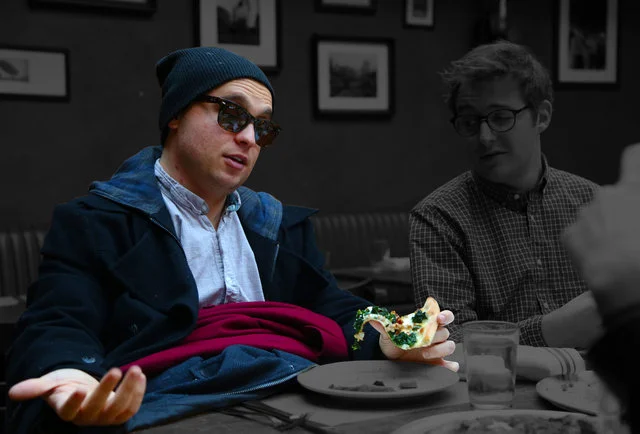

What Separates A Healthy And Unhealthy Diet? Just $1.50 Per Day
If you want to eat a more healthful diet, you're going to have to shell out more cash, right? (After all, Whole Foods didn't get the nickname "Whole Paycheck" for nothing.)
But until recently, that widely held bit of conventional wisdom hadn't really been assessed in a rigorous, systematic way, says , a cardiologist and epidemiologist at the Harvard School of Public Health.
So he and his colleagues decided to pore over 27 studies from 10 different developed countries that looked at the retail prices of food grouped by healthfulness. Across these countries, it turns out, the cost difference between eating a healthful and unhealthful diet was pretty much the same: about $1.50 per day. And that price gap held true when they focused their research just on U.S. food prices, the researchers found in their of these studies.
"I think $1.50 a day is probably much less than some people expected," Mozaffarian tells The Salt, "but it's also a real barrier for some low-income families," for whom it would translate to about an extra $550 a year.
Still, from a policy perspective, he argues, $1.50 a day is chump change. "That's the cost of a cup of coffee," he says. "It's trivial compared to the cost of heart disease or diabetes, which is hundreds of billions of dollars" — both in terms of health care costs and lost productivity.
Read more here VIA NPR
Rap's Roughest Words In The Mouths Of Kids
Those songs on the radio all the time? Kids can hear them too. Here they are, singing choice snippets.
Bohemian Rhapsody: Star Wars Edition
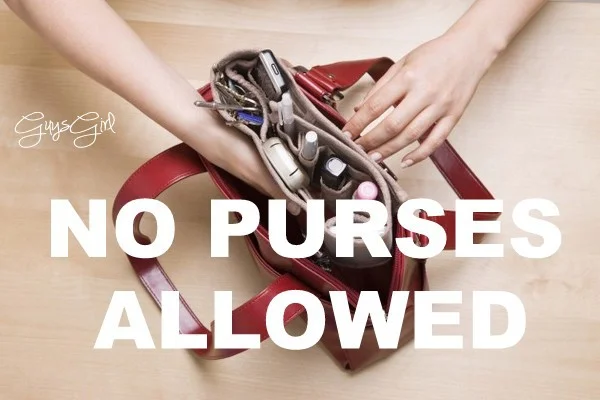
NFL Sparks Fan Displeasure by Banning Purses at Games
The era of the purse has come to an end—at least when it comes to lugging around stylish handbags to an NFL game.
Yahoo! Sports spotted a new policy the NFL is imposing around the league next season, and one that is sure to draw the attention and ire of anyone used to bringing a purse to a sporting event.
Read more here, with complete rules

Playboy turns 60 (Hef turns 103)
When describing their just-released 60th anniversary issue, editors at Playboy talk about celebrating “60 years of beautiful women, discerning taste, sexual emancipation, groundbreaking fiction, and world-changing journalism.” To that end, they put supermodel Kate Moss on the cover and dressed her up in traditional playmate garb: bunny ears, cottontail, and the French cuffs of a cater-waiter. Inside, she’s on all fours.
Exactly whose sexual emancipation are we talking about here?
Feminists have long rallied against Playboy as the ultimate manifestation of female objectification and indeed, editorial director Jimmy Jellinek has said of even Playboy’s recent years, “The magazine used to have this aesthetic of unattainable perfection” that prompted “unhealthy competition” among women. But all that was changing, he said, as the magazine sought to make efforts to attract a greater number of female readers with a “more healthy, naturalistic look.” CEO Scott Flanders has echoed this sentiment, saying: “We’ve got to be female-friendly.”
By the looks of things, it seems not much has changed over recent years, or the last 60—unless bunny ears, a cotton tail, and a submissive pose count as healthy and naturalistic or symbols of progress. Sure, the anniversary issue contains a panel of feminists speaking about the “best and worst of sexual liberation in modern America,” featuring participants who are at the top of their field: Erica Jong, Jane Pratt, Dr. Ruth—something one might never have seen in Hefner’s ‘50s-era Playboy. And yet, of the nearly 20 names listed on the new cover advertising the notables featured inside, just two women make the cut.
And then there’s the cover photo. The same people who argue that porn empowers women might argue that Playboy simply celebrates the unique physical beauty of woman—and that Moss is but the latest playmate to assert her power over Playboy’s legions of male reader-slaves. But depicting “a global icon and the most important supermodel of the last 25 years,” in Jellinek’s own words, as a man’s fantasy-at-the-ready—lips parted, bunny tail raised—isn’t empowering, or at all acknowledging of the progress women, and men, have made in the last half a century. It’s belittling, and dismissive, and plainly outdated. It is no longer every man’s fantasy to dominate a woman dressed as a furry woodland creature. It is no longer every woman’s fantasy to oblige.
It’s arguable that the Playboy of old, before all that sexual emancipation and, you know, women’s lib, was more refined and respectful. And at least back then, there was innovation. Celebrity nudity simply isn’t shocking anymore and, in most months, Playboy isn’t even uniquely offensive. Even the most “literary” of men’s magazines including Esquire and GQ routinely convince actresses to strip down to their underwear and tell jokes for the purpose of entertaining men. Show me a woman’s magazine that does the same—or, for that matter, a male celebrity who would go along with it under the guise of “empowerment.”
Read more: Playboy: Still Sexist After All These Years | TIME.com

Between Pigs And Anchovies: Where Humans Rank On The Food Chain
When it comes to making food yummy and pleasurable, humans clearly outshine their fellow animals on Earth. After all, you don't see rabbits caramelizing carrots or polar bears slow-roasting seal.
But in terms of the global food chain, Homo sapiens are definitely not the head honchos.
Instead, we sit somewhere between pigs and anchovies, scientists recently. That puts us right in the middle of the chain, with polar bears and orca whales occupying the highest positiohummn.
For the first time, ecologists have calculated exactly where humans rank on the food chain and how it's been changing over the past 50 years.
One trend is clear: Humans are becoming more carnivorous.
On average, people around the world get about 80 percent of their daily calories from fruits, vegetables and grains. The other 20 percent comes from meat, poultry and fish, scientists at the French Research Institute for Exploitation of the Sea in found.
"We are closer to herbivore than carnivore," the study's lead author, Sylvain Bonhommeau, Nature. "It changes the preconception of being top predator."
Read more here
Via NPR
How the way we walk can increase risk of being mugged
The way people move can influence the likelihood of an attack by a stranger. The good news, though, is that altering it can reduce the chances of being targeted.
How you move gives a lot away. Maybe too much, if the wrong person is watching. We think, for instance, that the way people walk can influence the likelihood of an attack by a stranger. But we also think that their walking style can be altered to reduce the chances of being targeted.
A small number of criminals commit most of the crimes, and the crimes they commit are spread unevenly over the population: some unfortunate individuals seem to be picked out repeatedly by those intent on violent assault. Back in the 1980s, two psychologists from New York, Betty Grayson and Morris Stein, set out to find out what criminals look for in potential victims. They filmed short clips of members of the public walking along New York's streets, and then took those clips to a large East Coast prison. They showed the tapes to 53 violent inmates with convictions for crimes on strangers, ranging from assault to murder, and asked them how easy each person would be to attack.
The prisoners made very different judgements about these notional victims. Some were consistently rated as easier to attack, as an "easy rip-off". There were some expected differences, in that women were rated as easier to attack than men, on average, and older people as easier targets than the young. But even among those you’d expect to be least easy to assault, the subgroup of young men, there were some individuals who over half the prisoners rated at the top end of the "ease of assault" scale (a 1, 2 or 3, on the 10 point scale).
Read more here
Via BBC.com

Metals in your smartphone have no substitutes
A few centuries ago, there were just a few widely used materials: wood, brick, iron, copper, gold and silver. Today’s material diversity is astounding. A chip in your smartphone, for instance, contains 60 different elements. Our lives are so dependent on these materials that a scarcity of a handful of elements could send us back in time by decades.
If we do ever face such scarcity, what can be done? Not a lot, according to Thomas Graedel of Yale University and his colleagues who decided to investigate the materials we rely on. He chose to restrict his analysis to metals and metalloids, which could face more critical constraints because many of them are relatively rare.
The authors’ first task was to make a comprehensive list of uses for these 62 elements. This is a surprisingly difficult task. Much of the modern use of metals happens behind closed doors of corporations, under the veil of trade secrets. Even if we can find out how certain metals are used, it may not always be possible to determine the proportions they are used in. Their compromise was to account for the use of 80% of the material that is made available each year through extraction and recycling.
Read more here Via theconversation.com

The Death of Imaginary Play
Johnny Jones, 10, was reportedly suspended from South Eastern Middle School in Fawn Grove, Pa. for "shooting" an imaginary arrow at a classmate.
The Rutherford Institute, which is defending Jones, claims the fifth grader was told he violated the school’s zero tolerance policy on weapons when he drew back the strings of an imaginary bow and “shot” an imaginary arrow at a buddy.
That's when an unidentified girl in the class told the teacher, who referred the incident to the principal, claiming that “firearms” had been involved.
Jones was allegedly suspended for one day and threatened with expulsion for “making a threat” to another student using a “replica or representation of a firearm."
The Rutherford Institute sent a letter to the school on Dec. 4, which states in part: “We request that you rescind the suspension and immediately remove all reference to it from Johnny’s permanent school record.”
“There is no reason that Johnny should be stigmatized and branded a miscreant due to the school’s unreasonable application of its zero tolerance policy against him,” states the letter.
Rutherford Institute President John W. Whitehead claims the school’s response is an effort to “criminalize childish behavior and punish all offenses severely, no matter how minor or non-threatening the so-called infraction may have been.”
“We all want to keep the schools safe, but I’d far prefer to see something credible done about actual threats, rather than this ongoing, senseless targeting of imaginary horseplay,” said Whitehead.
According CNSNews.com, the Rutherford Institute has given Rona Kaufmann, Superintendent of the South Eastern School District, until Dec. 13, 2013 to respond to their letter.
There has not been a statement from the school or Kaufmann.
More here via opposingviews.com
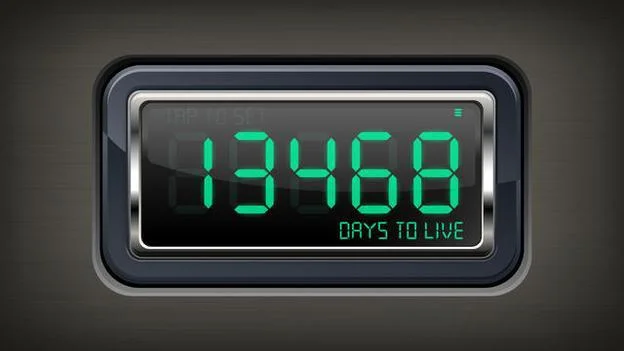
Deathwatch; Theres is an app for that....
At the time of this writing, there are sixteen thousand two hundred and seventy-seven days remaining in my life. I know this because an app I have installed on my phone tells me so. I downloaded it about a week ago, back when I still had sixteen thousand two hundred and eighty-four days left to live, a number that strikes me in retrospect as an embarrassment of riches, days-wise. By the time you read this, I will have even fewer days left to live. Depending on the turnaround time for this piece, I could be down to a number as low as sixteen thousand two hundred and seventy. I’m running out of days here, is what the app is telling me, in its bluntly literal way.
This little contrivance is called Days of Life, and it’s as chillingly simple and straightforward as its name suggests. Here’s how it works: you punch in your date of birth, your gender, and the country you live in, and then it estimates your life expectancy based on these variables. I happen to be male and Irish and so, by the reckoning of the app, I will live for seventy-nine years. (If I happened to reside in either of the two options above or below Ireland on the scrolling list of countries in the settings—Iraq or Israel—I’d be looking at sixty-five and eighty years, respectively.) It won’t take any further particulars into consideration; it doesn’t care whether I’m a smoker, what my B.M.I. or my income is, whether anyone in my immediate family has died from cancer. No: I’m a thirty-four-year-old Irishman, and so I’ve got sixteen thousand two hundred and seventy-seven days left to live.
Actually, it’s more like sixteen thousand two hundred and seventy-six and three-quarters now because, what with one distraction or another, it’s taken me an absurdly long time to get the preceding two paragraphs written. (How did this happen? Where did the time go, and why did I allow it to get away? Did I really need to answer those e-mails, read those tweets, make and drink those cups of coffee?) And this is essentially the point of the app. It’s supposed to make you think like this—to terrify you into productivity, turning mortal dread into a procrastination preventative.
At the top of the screen, there’s a digital-clock-style display that informs you how many days you’ve got left. This is grim enough, of course, but what’s really unsettling is the circular pie chart that takes up the bottom half of the screen. When you fire up the app, this circle is entirely filled with little green dots; but then, in a sickening, clockwise sweep, these dots begin to turn orange, until the proportion of your life that has already passed—gone, finished, irredeemably over—is represented in contrast to the only slightly larger proportion that remains. And, suddenly, you’re looking at your life in pie-chart form: a handy infographic of personal transience, an illustration of how close you’re getting to being dead. It’s the Quantified Self in its most reductive form.
Read more here
Via The New Yorker
E Cigarettes not Hipster Enough for You? Raise you Pocket Hookah
...."the iPod of getting baked"
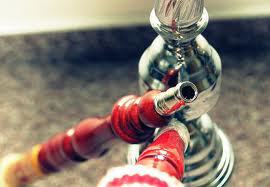
They can look like nondescript writing pens or asthma inhalers. Some resemble lip-gloss sticks and come in the same hot pink or sparkly purple as teenage girls' smartphone cases.
Others are bullet-like cylinders hanging on fat gold neck chains like gangsta bling. Some come boxed in a rainbow of neon colors looking a lot like marking pens.
Portable pot vaporizers — called "vapes" or "pocket hookahs" by users — are going hand-in-hand with the proliferation of electronic cigarettes and taking the marijuana world by storm. They are so well disguised and can be used so clandestinely that they are setting off alarm bells with those concerned about keeping legalized pot out of the hands of minors.
"This is incredibly concerning," said Bob Doyle, executive director of the Colorado Tobacco Education and Prevention Alliance. "The marijuana vaporizing industry is as advanced or more advanced than the e-cigarette industry. The products are appealing to kids, and they promote the ability to hide marijuana use."
That is "absurd," said Mason Tvert, co-founder of Safer Alternative for Enjoyable Recreation. He said the vaporizers have been developed as a safer way for adults to consume marijuana without smoking it and without creating secondhand smoke.
"These products are not made, marketed or sold for kids," Tvert said.
A 31-year-old hardcore athlete and regular user of a pocket vaporizer, who asked that his name not be used, said he agrees with Tvert's assertion that vaporizers are meant as a safer alternative to smoking pot.
"I do it because it is more healthy," he said.
And more easy to disguise, he added.
"If you have ever tried to smoke on a chairlift while skiing, you can appreciate a good hand-held vaporizer. They draw little attention, are fairly odorless and work despite gale-force winds," he said.
The pocket vaporizers are made up of an atomizer and a battery unit that acts as a heater to create a breathable vapor. The batteries are charged with small wall plug-ins.
The fact that the vaporizers are tiny electronic devices with chargers like those used for other popular electronic devices prompted Rolling Stone magazine, in its June issue, to refer to them as "the iPod of getting baked."
Read more here
Via Denverpost
How sleep makes your mind more creative
It’s a tried and tested technique used by writers and poets, but can psychology explain why first moments after waking can be among our most imaginative?
It is 6.06am and I’m typing this in my pyjamas. I awoke at 6.04am, walked from the bedroom to the study, switched on my computer and got to work immediately. This is unusual behaviour for me. However, it’s a tried and tested technique for enhancing creativity, long used by writers, poets and others, including the inventor Benjamin Franklin. And psychology research appears to back this up, providing an explanation for why we might be at our most creative when our minds are still emerging from the realm of sleep.
The best evidence we have of our mental state when we're asleep is that strange phenomenon called dreaming. Much remains unknown about dreams, but one thing that is certain is that they are weird. Also listening to other people's dreams can be deadly boring. They go on and on about how they were on a train, but it wasn't a train, it was a dinner party, and their brother was there, as well as a girl they haven't spoken to since they were nine, and... yawn. To the dreamer this all seems very important and somehow connected. To the rest of us it sounds like nonsense, and tedious nonsense at that.
Yet these bizarre monologues do highlight an interesting aspect of the dream world: the creation of connections between things that didn't seem connected before. When you think about it, this isn't too unlike a description of what creative people do in their work – connecting ideas and concepts that nobody thought to connect before in a way that appears to make sense.
No wonder some people value the immediate, post-sleep, dreamlike mental state – known as sleep inertia or the hypnopompic state – so highly. It allows them to infuse their waking, directed thoughts with a dusting of dreamworld magic. Later in the day, waking consciousness assumes complete control, which is a good thing as it allows us to go about our day evaluating situations, making plans, pursuing goals and dealing rationally with the world. Life would be challenging indeed if we were constantly hallucinating, believing the impossible or losing sense of what we were doing like we do when we're dreaming. But perhaps the rational grip of daytime consciousness can at times be too strong, especially if your work could benefit from the feckless, distractible, inconsistent, manic, but sometimes inspired nature of its rebellious sleepy twin.
Scientific methods – by necessity methodical and precise – might not seem the best of tools for investigating sleep consciousness. Yet in 2007 Matthew Walker, now of the University of California at Berkeley, and colleagues carried out a study that helps illustrate the power of sleep to foster unusual connections, or “remote associates” as psychologists call them.
Under the inference
Subjects were presented with pairs of six abstract patterns A, B, C, D, E and F. Through trial and error they were taught the basics of a hierarchy, which dictated they should select A over B, B over C, C over D, D over E, and E over F. The researchers called these the “premise pairs”. While participants learnt these during their training period, they were not explicitly taught that because A was better than B, and B better than C, that they should infer A to be better than C, for example. This hidden order implied relationships, described by Walker as “inference pairs”, were designed to mimic the remote associates that drive creativity.
Participants who were tested 20 minutes after training got 90% of premise pairs but only around 50% of inference pairs right – the same fraction you or I would get if we went into the task without any training and just guessed.
Read more here Via BBC
Funny vintage kissing manual from 1942


More men speaking in girls' 'dialect', study shows
More young men in California rise in pitch at the end of their sentences when talking, new research shows.
This process is known as "uptalk" or "valleygirl speak" and has in the past been associated with young females, typically from California or Australia.
But now a team says that this way of speaking is becoming more frequent among men.
The findings were presented at the Meeting of the Acoustical Society of America in California.
"We found use of uptalk in all of our speakers, despite their diverse backgrounds in socioeconomic status, ethnicity, bilingualism and gender," said Amanda Ritchart, a linguist at the University of California who led the research.
"We believe that uptalk is becoming more prevalent and systematic in its use for the younger generations in Southern California," she added.
The World's Most Popular Drink Is ... Not Beer
...soju, a Korean spirit that Psy calls his 'best friend'

Vodka and tequila, head to the back of the bar. The world's most popular alcoholic drink is a South Korean spirit called soju, which has topped a best-selling-drink list for years and sold 65 million cases on this year's list alone, the Guardian reports. It's made from barley, wheat, or rice—or other starches like potatoes or tapioca—and is loved partly because its alcohol content often hovers around 25% ... perfect for a few refills without passing out. Bars from London to New York to San Francisco are hawking soju drinks, often with sweet fruit flavors to make them go down easy. Traditionalists can enjoy it with Korean foods like the fish-and-rice cake tteokpokki or salted shrimp. "Soju is often drunk with jokbal, which is pork trotter cooked in a seasoned, well-flavored broth," says a Korean chef. "It also goes well with bossam—steamed pork wrapped in a red lettuce leaf with garlic, peppers and kimchi." And beer-lovers can get into somac—ways of mixing beer with soju, like covering your blend with a tissue before slapping and swirling it into a "Hurricane." Koreans like to hurl the wet napkin at the ceiling to see if it sticks! For more on soju, check out a Psy video that helped make it popular.
Via Newser
The Slate Book Review Top 10 of 2013
Forty-one False Starts: Essays on Artists and Writers
Bleeding Edge by Thomas Pynchon
The Flamethrowers by Rachel Kushner
Going Clear: Scientology, Hollywood, and the Prison of Belief by Lawrence Wright
The Goldfinch by Donna Tartt
Lean In: Women, Work, and the Will to Lead by Sheryl Sandberg
The Love Affairs of Nathaniel P. by Adelle Waldman
A Prayer Journal by Flannery O’Connor
Tenth of December by George Saunders
Wool by Hugh Howey
Read more here Via Slate.com

Restaurant workers’ wages are routinely docked when customers walk out on their tab.
Last month, a New York City waitress who’d just been fired after she refused to cover the $96 tab of a party who walked out without paying posted an angry message on Reddit. Her story earned sympathy from other Redditors and soon went viral, with a hand from Gawker. Many commenters on Gawker and Reddit were outraged by the unfairness of the restaurant’s policy—it doesn’t seem right that a server should be held responsible for a customer’s dishonesty. The truth is this practice is far more common than most people outside of the restaurant industry might realize. Many servers are forced to perform two jobs at once: delivering food and working as a severely undertrained and underpaid security force. The dine-and-dash is often looked on as a harmless prank, without any serious consequences. Restaurants anticipate the occasional walkout as part of their business plan, right? They should, but instead they often pass the buck to employees—and when you learn that servers can be required to pay for the losses out of their own pockets, it doesn't seem all that funny.
Read more here via Slate

Brennan's Inc., former owner of the landmark restaurant, is bankrupt
Brennan’s Inc., the family-owned company that formerly operated the landmark French Quarter restaurant at 417-425 Royal St., was forced into bankruptcy Thursday, (Dec. 5) in United States Bankruptcy Court for the Eastern District of Louisiana, according to Todd Slack, an attorney for Ted Brennan and his daughter Bridget Brennan Tyrrell.
FBI can secretly turn on laptop cameras without the indicator light
Scary. Insane. Ridiculous. Invasive. Wrong. The Washington Post reports that the FBI has had the ability to secretly activate a computer's camera "without triggering the light that lets users know it is recording" for years now. What in the hell is going on? What kind of world do we live in?
Marcus Thomas, the former assistant director of the FBI's Operational Technology Division, told the Post that that sort of creepy spy laptop recording is "mainly" used in terrorism cases or the "most serious" of criminal investigations. That doesn't really make it less crazy (or any better) since the very idea of the FBI being able to watch you through your computer is absolutely disturbing.
More here via Gizmoto