
A Look at Amazon's Fire Smart Phone
Amazon’s Fire Phone innovates with its four-camera configuration. It innovates with its object-identifying Firefly feature. And it innovates with its Mayday feature that provides face-to-tracked-face assistance on the go.
But one way in which it doesn’t innovate may be the way that most people were hoping it would: price. Available for $199 on a two-year AT&T contract or $649 unlocked, the Fire Phone is similar to other premium phones such as the iPhone 5S and Samsung Galaxy S5.
The Fire Phone’s failure to disrupt has led many to question whether it is keeping the Amazon flame. Indeed, the cellular options available to Fire Phone buyers are less creative than the limited free data option Amazon offered with AT&T at the release of the Kindle Fire HD.
When Amazon entered the tablet market with the $199 Kindle Fire, it set off a price war. Jeff Bezos noted that the company produces “premium products at a non-premium price.” But while Amazon has shown some willingness to follow others down the ladder as tablet pricing has collapsed, offering the Kindle Fire HD for $139, still a far cry from the sub-$100 tablets littering the pages of Walmart.com.
But, perhaps burned by that competitive tablet, things changed when the company introduced the Kindle Fire HDX, with its leading-edge processor and display technology. At a starting price of $229 for the 7-inch version, it is significantly less than the $299 iPad Mini, but so is nearly every other tablet below 8 inches.
A better comparison would be with the Google Nexus 7, also priced at $229. Amazon’s next category expansion — Fire TV, also loaded with powerful internals — came in at $99, the same price as Apple TV and the highest-end Roku player.
It’s not unusual for brands to climb the prestige ladder as their sales grow. HTC, for example, was once a company that developed phones and PDAs for other companies. In the 1980s, Samsung’s electronics were dismissed as cheap junk. Now, both are focused mostly on high-end gadgets.
But what Amazon is doing is more like a cross-country expedition than one up a mountain. As Jeff Bezos pointed out early in the Fire Phone presentation, its brand has strong recognition among consumers for customer satisfaction across several metrics.
And according to the YouGov brand index, which measures “brand health” across a variety of measures, Amazon was the #1 brand in 2013, with the Kindle sub-brand coming in 10th behind Cheerios. (Alas, the Fire Phone, like Fire TV, drops the “Kindle” delineation.) Amazon doesn’t need to raise the prestige of this brand, it just has to extend the influence of it.
There’s another factor at play. The Fire Phone has its share of features designed to keep you at a buying level Amazon finds palatable. However, much more of what consumers do on phones — tasks such as taking photos, sending e-mail and messages, mapping and, yes, even having voice conversations — are more difficult to monetize. If, as Jeff Bezos said, Amazon monetizes when consumers use their devices (since they inevitably drive purchases on Amazon), there’s simply less of the usage pie that Amazon is getting, at least compared to AT&T.
The Fire Phone may not strike fear into the heart of Apple and Samsung for the time being, but it’s clearly not intended to. It’s about providing an option to Amazon’s loyal customers in a product category where its ecosystem advantages are too diluted to disrupt at this point.
VIA VB
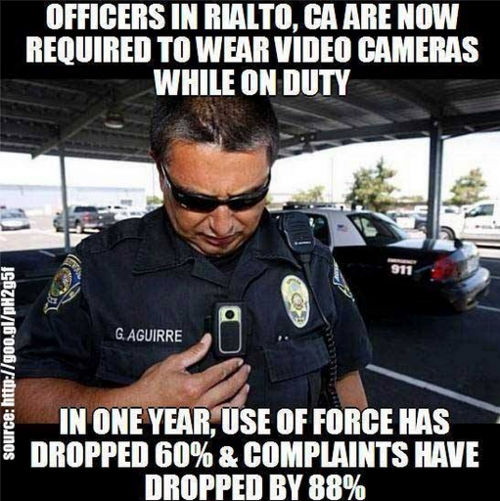
Police Use Of Force Drops 60% When Officers Required To Wear Video Cameras
Rialto, CA- The Rialto Police Department, over the past year, has been experimenting with equipping body cameras to the 70 officers on its force. The initial results show a promising solution to the excessive use of force by officers.
The police chief in Rialto, Tony Farrar, is on record as stating, “ I think we’ve opened some eyes in the law enforcement world. We’ve shown the potential.”
This potential he speaks of is due to the scientific data that this experiment has yielded over the course of the last year. The body cameras were introduced on officers in February 2012, over the next twelve months total complaints filed against them dropped by a staggering 88%, with use of force by officers dropping by 60%.
With the cameras there has been an improvement in officer’s demeanor and tone towards those they serve. As Chief Farrar noted, “With a camera they are more conscious of how they speak and how they treat people.”
When those in a position of authority are watched they are less likely to abuse that authority. Chief Farrar says, “That’s just human nature. As an officer you act a bit more professional, follow the rules a bit better.” In addition it also helps protect officers from false accusations of excessive use of force.
Chief Farrar is providing a new paradigm for policing, taking a proactive approach rather than making excuses for his officers and toeing the line. To his credit he has a master’s degree from the Cambridge Institute of Criminology, from which stemmed the idea to utilize cameras.
By holding officers more accountable, expensive lawsuits and payouts can be avoided, making it fiscally, as well as socially responsible. Even the ACLU has come out in support of the move, saying that with proper oversight and accountability, even privacy concerns would be outweighed.
The scientific evidence clearly demonstrates that this program could be an effective and efficient model for nationwide police reform. If you would like to see a similar program implemented in your area, get in touch with your mayor/city council/county board and demand cameras on officers in your local jurisdiction.
VIA benswann.com

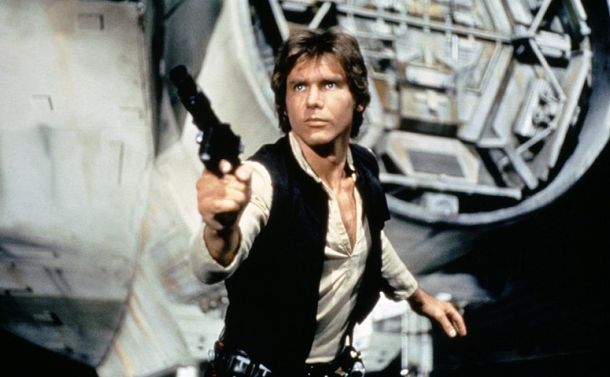
Hans Solo Completely Screwed Up Episode VII
Uh-oh. Please take out your official Star Wars: Episode VII Salt Lick, but now that it's been officially revealed that Harrison Ford's leg is broken, the rumor is he'll be sidelined for six full months — which means the movie's either getting delayed or massively rewritten.
The potential news comes from the UK-based site Jedi News, who says sources told them of an emergency meeting ay Pinewood Studios this morning to discuss how to handle Ford's sudden unavailability. Since Ford's Han Solo is reportedly the film's lead, the only way to make its Christmas 2015 release date — which Disney has refused to move before — is to rewrite Ford's scenes, or rewrite the script entirely.
Assuming Ford is indeed the main character (which is itself a no-brainer), I honestly don't know how this rumor isn't true. Unless the script has Han Solo sitting down most of the time, something will need to change to accommodate Ford's injury, and that's either the script or the release date. The question is whether Disney would rather take the gamble on a Harrison Ford-light Episode VII movie in December '15, or whether Disney's shareholders and quarterly profit predictions and whatnot have the capacity to be patient.
If I had to guess, I think they'll wait; I think Disney will feel much more comfortable keeping Harrison Ford the movie's main star, no offense to Mark Hamill and Carrie Fisher. I also think the side-benefit of giving the film another six months of production time is better than trying force a full script rewrite at this point — as it stands, the movie is only 18 months away...
VIA i09
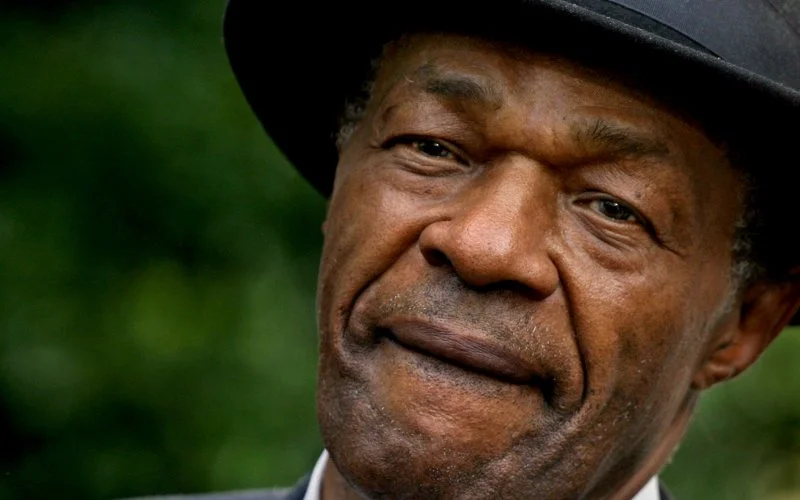
Yoga Tax Shows How Sharp Barry's Political Mind Is
Can we all agree he's lost it now? He was asked about THIS and but answered ...
Reporters at a Friday night dinner in honor of Ward 8 Councilmember and new author Marion Barry's autobiography got an unexpected lesson in health policy, as Barry explained the evils of the nonexistent "yogurt tax."
After a reporter asked Barry what he thought of the so-called "yoga tax" on yoga classes and gym memberships, Barry apparently thought the reporter was talking about yogurt, and he declared taxing the breakfast food "crazy."
“Yogurt is really more healthy than some other things, as is cottage cheese," said the 78-year-old ex-mayor.
Blame it on the D.C. Council's hectic budget season or the dinner's location at K Street NW's Look lounge, where a noisy singles mixer was also going on. Either way, Barry went on to name a possible culprit behind the imaginary tax: Ward 2 Councilmember Jack Evans.
“I don’t know who proposed that," Barry said. "I think Jack proposed that. I’m not sure. But whoever proposed it, it shouldn't be."
Barry, whose spokeswoman didn't initially respond to a request for comment on the confusion (see update below), will be happy to find out that the tax doesn't exist at all. Evans spokesman Tom Lipinsky confirms to LL that his boss hasn't proposed a yogurt tax and doesn't plan to.
Barry's health advice at the dinner also included reading aloud the menu to the more than a dozen reporters, warning that the meat in a bolognese dish on the menu could stay in your body for 52 hours (Barry went for it anyway). As far as yogurt, Barry recommends organic varieties.
But don't think that all dairy products are safe. Barry worries that hormones passed on from cows are affecting children in puberty, an idea he got from activist and comedian Dick Gregory that's subject to some scientific controversy.
“Again, you notice what hormones do, are doing to our young people," Barry said. "You find young ladies—10, 11 years old, with fully developed breasts, fully developed bodies."
Update, 2:40 p.m.: Barry spokeswoman LaToya Foster says that Barry did not mean to refer to the imaginary "yogurt tax." Foster says she can't find any evidence of a yogurt tax at the Council.
“I’m sure that’s not what he meant," Foster says. "I’m sure that was just misheard."
VIA City Paper

Fitness Tax in DC
Over the past month, Shamika Bradley fell in love with the core-crunching workout that is Zumba. She recently joined one of the fastest-growing fitness classes in her neighborhood, one that city officials have heralded as a success.
“I’ve been so inspired by this class,” Bradley said. “My energy is up, I want to eat healthy. It’s helped so much.”
Far from the glitzy gyms that can cost $100 a month on the other side of the Anacostia River, Bradley’s Zumba class is held on an indoor basketball court at Fort Stanton Recreation Center in Ward 8.
Fewer than a dozen people show up. It is free. And it is the best option that Bradley, a 35-year-old project manager, has in this part of town, a river and a world away from a spirited debate about the “fitness tax.”
When a coalition of fitness buffs arrives at Tuesday’s council meeting to protest a proposed 5.75 percent sales tax on gyms and yoga studios in the District, it’s unlikely that any will be members of full-service private gyms east of the Anacostia. That’s because there are none.
On one side of the river are temples of fitness with tanning booths and rooftop pools, in a city where the number of gyms has grown by 11 percent since 2009. On the other side is a patchwork of boxing rings and workout classes at community centers and churches.
In other words, the debate about taxing yoga highlights yet another aspect of economic disparity in the city.
Over the past month, it has become impossible to walk downtown without seeing signs outside health clubs saying “#donttaxwellness.”
Last week, at least 60 people gathered on Freedom Plaza to protest. In the blazing sun, they performed a warrior yoga pose, physically illustrating their position against the proposed tax. They chanted, “Tax slurpees, not burpees!”
“There’s this illusion that yoga is for rich, white people. But a lot of people sacrifice to be able to afford classes,” said Greg Marzullo, 37, an instructor at Flow Yoga Center in Logan Circle, who attended the event.
Hawah Kasat, an artist and author who was host of the event, noted, “This is not a tax on the rich; it’s a tax on a virtue.”
Bradley is not without sympathy.
“That doesn’t make sense to try and punish people for being healthy,” she said, adding, “They don’t charge taxes for bike lanes.”
But in Bradley’s part of town, people don’t think of fitness as an entitlement. It’s a luxury that inspires appreciation.
“It’s a tremendous benefit to have someplace where I can work out in the area,” she said. “I’m grateful that there’s something here to do to stay in shape. I wish there was more.”
In Wards 7 and 8, the areas east of the Anacostia, the obesity rates are 35 percent and 44 percent, respectively, compared with 22.4 percent for the city as a whole. Residents and scholars alike attribute that to high poverty rates, the absence of grocery stores and a lack of access to gyms. In a city survey, one in three people in those wards reported that they work out less than once a month; in the city’s tonier neighborhoods, that number is closer to one in six.
Bradley’s Zumba class was a part of a city effort to increase wellness. The District’s parks department is installing outdoor fitness equipment as a part of a $35 million-plus initiative to reimagine the park system, with an emphasis on areas east of the river.
The proposed fitness tax came out of a local tax review commission that sought more money for the city coffers while cutting income taxes for the middle class.
Rather than increasing rates for services that already were taxed, the panel suggested that the city broaden its base, said Steven Rosenthal, a senior fellow at the Tax Policy Center. The revenue from taxing fitness clubs is projected to bring in $5 million.
The proposal has been supported by tax policy experts at the more conservative Cato Institute as well as the more liberal Fiscal Policy Institute. According to research from the International Health, Racquet & Sportsclub Association, 25 states tax health-club memberships. The group opposes the proposed fitness tax in the District.
Although the D.C. Council dismissed a plan to tax haircuts, Chairman Phil Mendelson (D) saw no issue with taxing gyms.
“We also have a sales tax on books,” he said. “That doesn’t mean we don’t want people to read.”
Mendelson said the sales tax would affect a base that can withstand the blow, saying, “I do think that people who have memberships are probably better able to pay this sales tax.”
The proposal quickly caught the attention of gyms.
A coalition of gym owners has been trying to persuade council members to vote against the proposal. Ori Gorfine, the chief operating officer of the 4,000-member Balance Gym, noted that the inability to afford a membership was given as a reason in 11 percent of his gym’s cancellations.
Gorfine said the city could be shooting itself in the foot by discouraging health clubs from opening up in poorer neighborhoods.
“At the end of the day, gyms anchor development,” he said, adding: “Developers all the time call to ask if we want to start new businesses in different neighborhoods in the city. This [tax] makes us question whether it’s truly worth it.”
VIA Washington Post
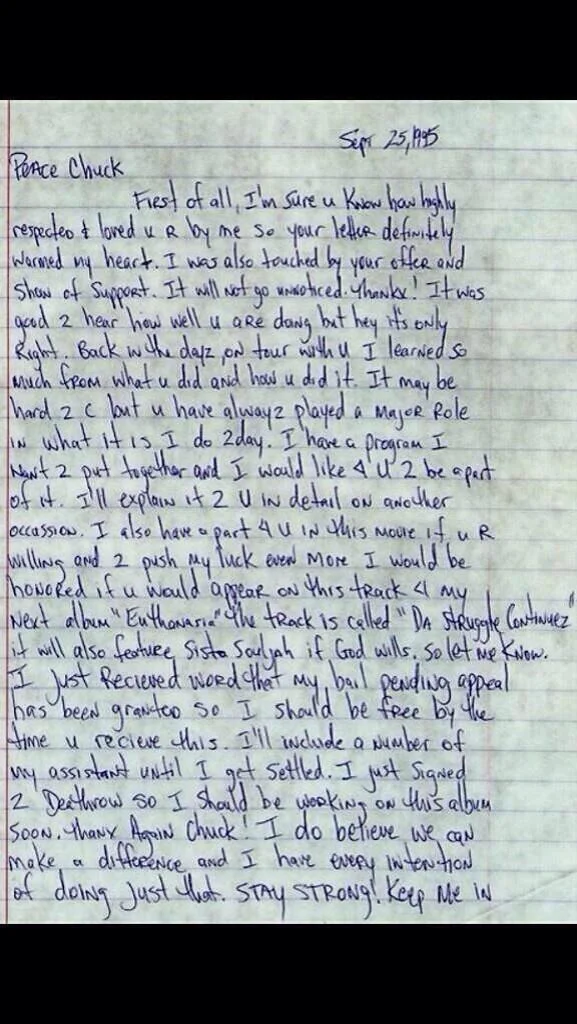
Read Tupac Shakur's Heartfelt Letter to Public Enemy's Chuck D
Chuck D has shared a letter that Tupac Shakur wrote to him detailing the respect he had for the Public Enemy emcee. In his tweet, Chuck wrote, "Letter from Pac, but you should have seen mine."
Shakur begins the letter, written in September 1995, noting how highly he regarded the Public Enemy mouthpiece and how much Chuck's letter of support meant to him. "Back in the dayz, on tour with u, I learned so much from what u did and how u did it," Shakur wrote. "It may be hard 2 C but u have alwayz played a major role in what it is I do 2day."
He went on to offer Chuck a few opportunities for collaboration, discussing a program he wanted to include Chuck in (though it's not clear what the program would be) and offering him a part in a movie. "And 2 push my luck even more, I would be honored if u would appear on this track 4 my next album, Euthanasia," he wrote. "The track is called 'Da Struggle Continuez.' It will also feature Sista Souljah, if God will. So let me know."
At the time he wrote the letter, Shakur was serving time in a New York prison following a conviction on two counts of sexual abuse in the first degree for offensive touching without consent. He mentioned making bail, pending appeal, for his sentence and said he hoped to be free by the time Chuck was reading the letter.
"I just got signed 2 Death Row, so I should be working on this album soon," he wrote. "Thanks again, Chuck! I believe we can make a difference, and I have every intention of doing just that. Stay strong!"
Shakur changed the title of his fifth album from Euthanasia to All Eyez on Me, though neither Chuck D nor Sister Soujah appeared on the album. That same year, he released the Makaveli album The Don Killuminati: The 7 Day Theory, which he finished days before his death. It is unclear whether "Da Struggle Continuez" was ever recorded.
Shakur was released from jail less than a month after writing the letter and was murdered just short of a year after writing it.

Detroit has begun shutting off water access, UN asked to help
Desperate calls for help from the United Nations aren’t just for war-torn and developing nations anymore. The city of Detroit—a city that has been on the brink in many ways—in an effort to balance its books, has begun shutting off water access to city residents behind on their payments. While that may seem like what happens to anyone when they don’t pay their bills, Detroit is a unique case—nearly half of the 323,900 residents who use the utility are delinquent, according to the Detroit Free Press. To make matters worse, Al Jazeera America reports, Detroit’s average monthly water bill is nearly double the national average of $40. The Detroit City Council approved a 9 percent hike last week.
In response, a coalition of activist groups in the city have appealed to the United Nations High Commission for Human Rights for relief. Here’s what they’re hoping for via Think Progress:
“We are asking the UN special rapporteur to make clear to the U.S. government that it has violated the human right to water,” said Maude Barlow, the National Chairperson of the Council of Canadians and a key member of the coalition that put the report together. In addition to creating international pressure to stop the Detroit shutoffs, Barlow said, the UN’s intervention could lead to formal consequences for the United States. “If the US government does not respond appropriately this will also impact their Universal Periodic Review,” she said, “when they stand before the Human Rights Council to have their [human rights] record evaluated.”
Earlier this year, to balance the department’s $118 million debt, the Detroit Water and Sewerage Department deployed crews to with the aim to cut some 3,000 residents’ access to the water supply each week as part of an effort to shut off water to more than 150,000 delinquent customers, according to the Detroit Free Press.
Eminem, Jack White, Lorde due at Music Midtown Festival
The list of performers for this year's Music Midtown Festival in Atlanta's Piedmont Park has been announced, and it's pretty star-studded.
The festival, now in its 21st year, will take place Sept, 19-20, with Eminem, the Zac Brown Band, John Mayer and Jack White sharing headliner duties. There will be plenty of familiar names supporting them, from Lorde, Lana Del Rey and Iggy Azalea to classic artists such as Gregg Allman and Run-DMC.
Other scheduled performers include Bastille, Fitz and the Tantrums, B.o.B, twenty one pilots, NEEDTOBREATHE, Mayer Hawthorne, AER, The Strypes, Banks, Sleeper Agent, Magic Man, Bear Hands and Ron Pope. More names are coming.
Tickets are available online beginning this Saturday at 10 AM EST, at musicmidtown.com and livenation.com.
VIA USA Today




Time travel 'may be possible', says new research
Physicists banish the 'grandparent paradox' with successful time-travel simulation
Physicists studying the behaviour of single particles of light say they can now discount one of the main theoretical objections to time travel.
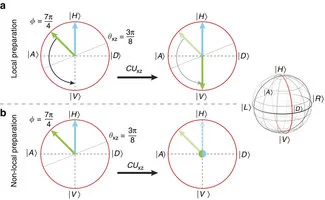
During research published in Nature Communications, scientists at the University of Queensland designed an experiment that simulated the effect of a photon – a particle of light – travelling back in time and interacting with its older self.
"Time travel was simulated by using a second photon to play the part of the past incarnation of the time-travelling photon," said University of Queensland physics professor Tim Ralph.
The lead author of the paper, PhD student Martin Ringbauer, said the experiment aimed to examine the intersection of quantum mechanics and Einstein's theory of relativity.
"The question of time travel features at the interface between two of our most successful yet incompatible physical theories," Ringbauer said. "Einstein's general relativity and quantum mechanics."
Einstein's theory of relativity suggests that it may be feasible to travel backwards in time by following a "space-time path" that doubles back and returns to its own starting point in space, but at an earlier time, NDTV news reports. Physicists refer to such paths as closed time-like curves (CTCs).
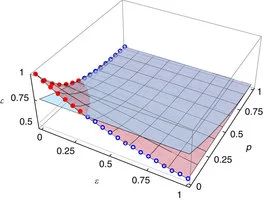
Researchers ran two versions of the experiment. In the first version, they looked at what might happen when a photon "travels through a wormhole into the past, then interacts with its older version". In the second case, they wanted to investigate what might happen when a photon "travels through normal space-time, but interacts with another photon that is trapped inside a CTC forever".
"The results revealed that time travel on a quantum level seems to be possible," the Daily Mail reports.
Physicists and philosophers have long struggled with the grandparent paradox. As Science Alert explains, a time traveller could in theory prevent his or her grandparents from meeting, "thus preventing the time traveller’s birth". This would make it impossible for the time traveller to have set out in the first place and kept the grandparents apart.
The new research suggests that such paradoxes may not render time travel impossible, the Mail notes, "albeit only on a quantum level for now".
Cuphead: Looks & Sounds Amazing
Have you ever wanted to walk into a 1930s cartoon? If so, Cuphead is here for you. Previewed briefly during the Microsoft Xbox Press Conference last week at E3, the game looks visually striking and unique to boot.
Studio MDHR, which developed the game, is aiming to launch later this year on Steam and Xbox One. It’s a great catch for Microsoft, which is trying to build a catalogue of unique and interesting games beyond the Call of Duty and Halo fare. The studio also hopes to release the game on the Sega Master System. Yes, the console that was released back in 1986. It would be the complete package, with a box, cartridge, and game manual.
The game follows the same style of early animation. Studio MDHR is taking the time to use actual cells and is inking by hand to create that classic effect. The music for the game is also live recorded Jazz, none of that MIDI stuff.
The game stars Cuphead, or Mugman if you and a buddy want to tackle the game co-op. It’s a run-and-gun shooter, kind of like Contra from back in the day. Unsurprisingly, Cuphead is a nominee for the International Games Festival.
Gordon Ramsay to End ‘Kitchen Nightmares’ Series in U.S. and U.K.
::weeps::

The next batch of U.K. episodes of “Kitchen Nightmares” will be the last for Gordon Ramsay, who announced the end of the British and Yank editions of the show on his website Monday.
“I’ve had a phenomenal 10 years making 123 episodes, 12 seasons, shot across 2 continents, watched by tens of millions of people and sold to over 150 countries. It’s been a blast but it’s time to call it a day,” Ramsay wrote in a post on his personal website.
The cooking reality show premiered in the U.K. in 2004 and the U.S. rendition bowed on Fox in 2007, featuring Ramsay’s visits to struggling restaurants. The chef would spend one week using his expertise trying to help the owners rehabilitate the business.
The format allowed Ramsay to show off his restauranteur bona fides as well as his attempts at family and couples counseling. Last year, the show hit its peak of pop culture buzz with an episode revolving around an Scottsdale, Ariz. eatery, Amy’s Baking Company, run by an over-the-top couple who produced plenty of Internet-friendly viral vid moments.
Ramsay credited “Kitchen Nightmares” for being “the show that really propelled my TV career.” The show has been a Friday night staple for Fox, with the most recent U.S. episodes airing in April and May. Fox has one more “Revisit” episode of “Kitchen Nightmares” in the can.
But Fox still has plenty of Ramsay on its air, between the competition series “Hell’s Kitchen,” airing now, “Hotel Hell” (bowing July 21) and the “MasterChef” and “MasterChef Junior” franchises.
At present, Ramsay is filming four final episodes of the U.K. “Kitchen Nightmares” for Channel 4.
On his website, Ramsay offered a list of “fun facts” about the show’s decade-long run:
- 123 restaurants in 99 cities within 2 countries were visited
- If you watched all episodes back-to-back it would run for 6,868 minutes
- Episodes sold into 150 territories globally
- The ‘Kitchen Nightmares’ format was produced locally for 30 territories around the world
- Swear count – 10,197
- The show brought in $37.3 million in ad revenue during the 2012-13 season – more than any other Friday Fox original series that season
- The show was the most viewed TV show across networks during the Friday time slot
- Tears – 0.4 gallons
- Meltdowns – 27
- Walkouts – 1
- Mice – 1
- Meows – 6
- First ever episode was watched by 5.7 million people
- 2 ulcers and 2.3 litres of Pepto Bismol
- 234 Zantacs consumed
Via Variety
Perhaps this will finally kill that Frozen song, Pearl Jam sings Let It Go

Meet DJ Maseo of De La Soul - Coming to Sunday Session at The Lodge At RedRocks Sun July 20th
Producer, DJ & part-time MC, Maseo a.k.a Plug 3 from the iconic hop-hop group De La Soul is one of the most respected and influential members in hip-hop history.
De La Soul burst onto the scene with their truly innovative and creative style of hip-hop by coloring outside the lines, sampling a diverse array of untouched and previously unsampled artists such as The Turtles and Hall & Oates on their critically acclaimed debut and hip-hop masterpiece "3 Feet High & Rising." Singles like “Me, Myself & I” broke major barriers in music and ultimately turned masses into hip-hop fans. De La Souls following album releases, “De La Soul Is Dead”, “Buhloone Mindstate” & “Stakes Is High” defined what most refer to as the golden era of hip-hop.
De La Soul has been a catalyst for other important acts in hip-hop history as well as they helped introduce to world the “Native Tongues” crew of MC’s consisting of A Tribe Called Quest, The Jungle Brothers and Black Sheep, while also credited for catapulting the careers of Mos Def and icon hip-hop producer, J-Dilla.
De La is perhaps the "oldest" functioning hip-hop group to still truly maintain credibility while not having "fell off" as they continue to stay relevant collaborating with MF Doom, Wu-Tang's Ghostface Killah, Madlib and Flosstradamus among others.
De La Soul’s largest collaboration to date being with Damon Albarn from Blur when he enlisted De La to participate on the Gorillaz track, "Feel Good Inc" which is the biggest single ever for both De La and Gorillaz. The track was featured on a massive Ipod worldwide TV campaign and won both acts a Grammy’s after their ensemble Grammy performance that included Madonna. Most recently, Maseo and De La Soul toured with Gorillaz worldwide where Damon would have entire stadiums chant Maseo's name to prompt his now infamous demented laugh to start off the performance of "Feel Good Inc."
Maseo is currently working on his "DJ-Conductor" concept album which has already yielded a popular single featuring Mac Miller called “I Bring the Soul He Brings the Funk.” Maseo is also working on a new De La Soul record and can currently be seen in the award-winning "Beats Rhymes & Life" A Tribe Called Quest documentary keeping the peace between the stars of the movie.
Maseo tours often on his own and can often be found DJ'ing after parties of the famous with his mix of Funk, Soul, Classic Hiphop, 80's, Old School and House. The Lodge At RedRocks is very excited to have Maseo on Sunday July 20th as part of our newest Sunday afternoon dance party, Sunday Session. See event page HERE.
YouTube will block videos from artists who don't sign up for its paid streaming service
Jack White and Adele could be blocked in some countries
As YouTube prepares to roll out an ad-free streaming music service, it will block videos from indie artists who don't sign up for the new offering, as originally reported by Financial Times. YouTube has signed deals with the major labels, and is explicitly threatening to block artists from using the entire YouTube platform — free or paid — if they do not agree to the terms of the new streaming service.
The FT quotes Robert Kyncl, YouTube’s head of content and business operations, confirming that the service plans to block videos from any artists or labels who have not signed on to its new paid service, "to ensure that all content on the platform is governed by its new contractual terms."
The Guardian points out that this would affect a number of big-name artists, potentially eliminating names like Jack White, Adele, and Arctic Monkeys from YouTube. A YouTube spokesman told The Verge, "Our goal is to continue making YouTube an amazing music experience, both as a global platform for fans and artists to connect, and as a revenue source for the music industry. We’re adding subscription-based features for music on YouTube with this in mind — to bring our music partners new revenue streams in addition to the hundreds of millions of dollars YouTube already generates for them each year. We are excited that hundreds of major and independent labels are already partnering with us."
A source familiar with the situation has confirmed to The Verge that most of the details in the FT story were accurate. YouTube does not want to launch a paid service and then be forced to show some videos in ad-supported mode, or offer users the ability to take videos offline, but not be able to offer that for big names like Adele or Jack White. It is going to begin blocking artists whose labels have not signed on to its new licensing terms in the countries where those deals apply starting within just a few days, although the paid service is not expected to roll out that soon.
Speed Read: Marion Barry’s Crazy Memoir
From giving advice to Bill Clinton to the FBI trying to kill him, the juiciest bits from Marion Barry’s new memoir.
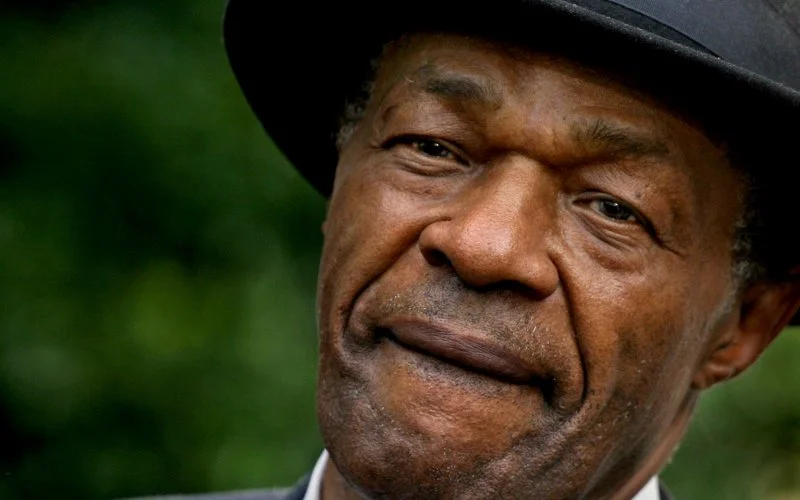
When it comes to iconic crack-smoking mayors, Rob Ford is a pale imitation when compared to former Washington, D.C., Mayor Marion Barry Jr. Barry was not only caught on video smoking crack and arrested by the FBI, but he was then reelected to the position of mayor after being released from jail.
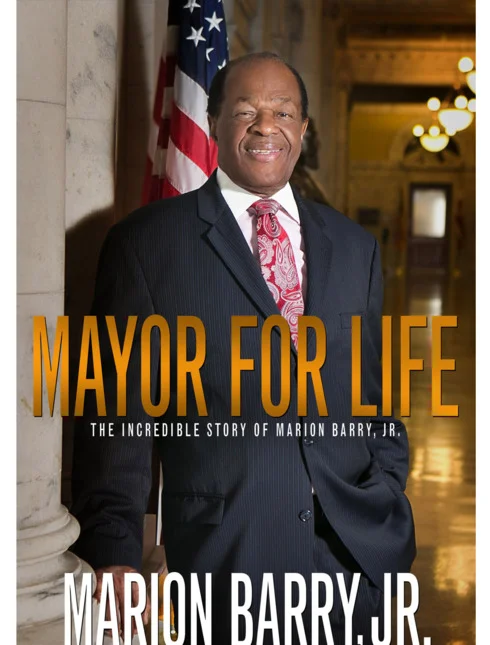
Barry, who now serves on the D.C. City Council, has just published a tell-all memoir, Mayor For Life: The Incredible Story of Marion Barry, Jr. Here are the juiciest bits.
Bill Clinton called him for advice.
According to Barry, in the aftermath of the Monica Lewinsky scandal, then-President Bill Clinton turned to him for advice. Barry claims that Clinton talked to him for 20 minutes about what to do when you’re mired in controversy. Barry told him to “stop digging the hole” that put him in the situation. He ends the anecdote with a line sure to make Clinton camp cringe, declaring, “He could identify with me.”
He tried cocaine for sexual reasons.
In the memoir, Barry recounts one of his drug encounters in memorable fashion. He was at a house party when a good-looking woman came out of the bathroom and told him about the cocaine she was doing. “You want some?” she apparently asked him. “This makes my pussy hot.”
And because he was a grown-up male in a position of power, he walked away.
Just kidding.
Barry says he wanted to know how “it would make me feel” and so thought “What the hell? Why not?” But when he tried to snort the cocaine off a business card, he blew the wrong way and knocked the powder off the card. Barry tried again, and shares the experience with no detail left out. It “went straight to my penis,” he writes, and then he had sex with the woman.
White people were out to get him.
One of the major sources of Barry’s power over the decades was playing off of simmering racial resentment in a majority-black city that had long been controlled by white people. According to Barry, the changes he brought about as mayor are the reasons for his downfall.
Barry claims the FBI went after him at the Vista Hotel because powerful white people did not like him “creating all these opportunities for black folks.” Even more incendiary, Barry asserts the FBI was actually trying to kill him.
Also, if you’re white, put down the book.
Perhaps aware that his book may make white readers uncomfortable, Barry makes it clear his response to that potential question. “Well, let me tell you,” he writes, “I’m black and my life has been about uplifting black folks.” He then goes on to say, sure, there’s a spot for white people in his fight, but the books have left out black people, so he’s making amends.
His relationship with ex-wife Effi Barry is squirm-inducing.
Effi Barry, the former first lady of Washington and Barry’s former wife who stood by him during the scandal, is described in two different ways. First, when it came to Barry’s roving eye and his drinking, “Effi would ignore it all and never let it bother her. She wasn’t a jealous woman.”
Then there is the Effie who emptied one of their bank accounts because she “liked to shop and look nice.”
About those womanizing charges, they’re untrue, except, not really.
Barry described the reports of him having affairs as “unfounded” and “crazy.” To Barry, they were attempts to smear a black mayor.
Except, pages later, he defends those unfounded accusations by saying men have “need of companionship” and that he did in fact get involved with women. His actions with women led him to write the bizarre line that “I have to forgive myself, even in my older age, from being a normal man with feelings for a woman.”
Also contradicting his claims about not womanizing, is that his very reason for doing crack with Rasheeda Moore the night of his arrest was that he thought she would have sex with him if he did it with her.
He takes shots at his successors.
Unsurprisingly, the mayors who have come after Barry don’t quite live up to his legacy. Vincent Gray, the current mayor Barry supported, has messed up worse than anybody Barry has ever seen, which, of course, “could have been avoided had Mayor Gray “consulted with other mayors and me.”
As for Adrian Fenty, who Barry once supported and then turned on, he was “arrogant,” a “disappointment,” and guilty of cronyism.
Sharon Pratt Kelly, the woman who won after Barry’s conviction, left the District in dire financial straits. Barry also blames her for losing the Redskins’ stadium.
VIA DailyBeast
In Landmark Decision, U.S. Patent Office Cancels Trademark For Redskins Football Team
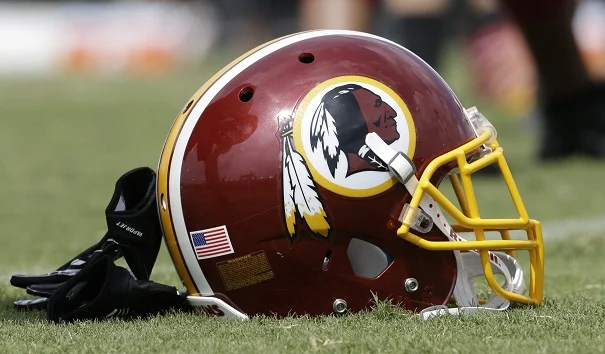
The United States Patent and Trademark Office has canceled six federal trademark registrations for the name of the Washington Redskins, ruling that the name is “disparaging to Native Americans” and thus cannot be trademarked under federal law that prohibits the protection of offensive or disparaging language.
The U.S. PTO’s Trademark Trial and Appeal Board issued a ruling in the case, brought against the team by plaintiff Amanda Blackhorse, Wednesday morning.
“We decide, based on the evidence properly before us, that these registrations must be cancelled because they were disparaging to Native Americans at the respective times they were registered,” the board wrote in its opinion, which is here. A brief explanation of how the Board reached its decision is here.
“The Trademark Trial and Appeal Board agreed with our clients that the team’s name and trademarks disparage Native Americans. The Board ruled that the Trademark Office should never have registered these trademarks in the first place,” Jesse Witten, the plaintiffs’ lead attorney, said in a press release. “We presented a wide variety of evidence – including dictionary definitions and other reference works, newspaper clippings, movie clips, scholarly articles, expert linguist testimony, and evidence of the historic opposition by Native American groups – to demonstrate that the word ‘redskin’ is an ethnic slur.”
“I am extremely happy that the [Board] ruled in our favor,” Blackhorse said in a statement. “It is a great victory for Native Americans and for all Americans. We filed our petition eight years ago and it has been a tough battle ever since. I hope this ruling brings us a step closer to that inevitable day when the name of the Washington football team will be changed. The team’s name is racist and derogatory. I’ve said it before and I will say it again – if people wouldn’t dare call a Native American a ‘redskin’ because they know it is offensive, how can an NFL football team have this name?”
The Trial and Appeals Board rescinded the team’s trademark protections in a 1999 ruling that was part of a case filed in 1992. A federal court later overturned the ruling on appeal due to a technicality that the plaintiffs say has been fixed in this most recent case.
The team will appeal the case, according to a statement from its attorney, and it will be able to keep its trademark protection during appeal. Further, losing the trademark would not force the team to change its name — as the PTO pointed out in its fact sheet about the case, the Trial and Appeal Board “does not have jurisdiction in a cancellation proceeding to require that a party cease use of a mark, but only to determine whether a mark may continue to be registered.”
The absence of federal trademark protection, however, could limit the team’s legal protections to state and common laws when others use their name, so others can’t just start marketing new “Redskins” merchandise. Still, it could potentially cost the team — and, because of the NFL’s revenue-sharing model, other NFL teams — money. In the previous case, the team’s attorneys argued that losing trademark protections and the exclusive right to their brand would cause “every imaginable loss you can think of.” For that reason, targeting the trademark has long been thought of by opponents of the team’s name as the easiest avenue to changing it.
The team is confident that it will prevail on appeal.
“We’ve seen this story before. And just like last time, today’s ruling will have no effect at all on the team’s ownership of and right to use the Redskins name and logo,” team attorney Bob Raskopf said in the statement. “We are confident we will prevail once again, and that the Trial and Appeal Board’s divided ruling will be overturned on appeal. This case is no different than an earlier case.”
.........4 days.....for Instagram? No Instagram should take FOUR DAYS
Kanye West blasts Leibovitz, says wedding Instagram took 4 days
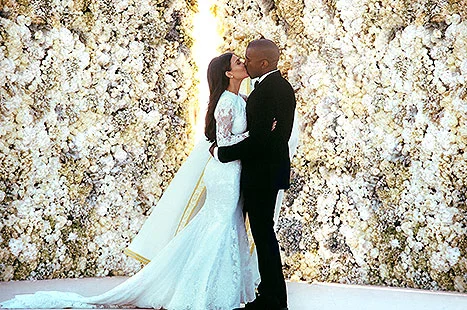
CANNES — Kanye West revealed his official wedding photo with Kim Kardashian took four days to produce after top photographer Annie Leibovitz pulled out of their wedding one day before the big event.
Kanye blasted Leibovitz, who shot him and Kim for the cover of Vogue, for ditching their over-the-top nuptials with just one day to go, saying, “She was afraid of celebrity.”
He added that he then spent four days of his honeymoon perfecting the photo of himself kissing Kim at the altar in Florence in front of a wall of roses.
Kanye explained, “Let me tell you something about that kiss photo that my girl put up … this was pissing my girl off during the honeymoon, she was exhausted because we worked on the photo so much because Annie Leibovitz pulled out right before the wedding. I think that she was, like, scared of the idea of celebrity.”
Via Page Six
Enjoy these Kayne Quotes of Crazy
1. “We worked on our wedding photo for four days until it was good enough for Instagram.”
2. “I’ve been brought up in this way—I think I can't work with anyone that isn't number one: Jay Z, Kim, Obama, Apple is one, Samsung isn’t.”
3. "Trends come and go, but cool is forever.”
4. "If people are saying you're wrong, it's probably a good sign that you're a genius.”
5. "Bad taste is vulgar. The world as a whole is f--king ugly. And the Internet too. But I'm not in the construction business.”
Bonus Quote: “Rome wasn't built in a day; the Internet is our new Rome. Empower the best content creators or f--k you!"
Starbucks is a little less evil today
It pays to be an educated employee at Starbucks, literally.
The company announced a new program to help its baristas earn an online college degree.
"Thank you so much Howard, it's a pleasure."
Starbucks employee Tammie Lopez personally thanked CEO Howard Shultz for the opportunity to attend college for free.
Howard Schultz/Starbucks CEO says, "This is not about PR. This is about the future of the company, what's doing right for our people."
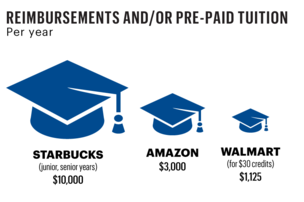
Schultz was in New York to announce that starting this fall, Starbucks will help employees get an online bachelor's degree at a steep discount.
And they don't have to stay with the company after they finish.
Starbucks is partnering with Arizona State University.
Eligible workers can choose from more than 40 undergraduate online programs.
Freshman and sophomores could receive partial scholarships and full tuition reimbursement as juniors and seniors.
How important is a college degree these days, to you? Tammie: To me, very important.
Lopez has been working part–time a Starbucks while going to school for more than a year.
She plans to apply for the new program to study business.
Tammie Lopez/Starbucks Employee says, "I never thought I would be getting assistance and help that Starbucks has provided. It just never crossed my mind. And I think that's why it so mind blowing."
Dozens of corporations with hourly employees offer some kind of tuition assistance or discount – but the Starbucks plan is one of the most generous.
Howard Schultz/Starbucks CEO says, "We can't build a great company and we can't build a great enduring country if we constantly leave people behind."
Schultz says if Starbucks were a 20 chapter book — the company would only be at chapter 4 or 5. Only workers at Starbucks 8,200 company–operated stores are eligible and they have to work an average 20 hours per week.
VIA KEYC.com
Watch OK Go's Eye-Boggling 'Writing's on the Wall'
Past OK Go videos have featured everything from dancing dogs to an extraordinarily complex Rube Goldberg machine, but their latest clip for "The Writing's on the Wall" is stripped down — relatively speaking. The video — which we're premiering here today after a sneak peek earlier last week — features the band's four members moving through a Brooklyn lot, where a series of perspective illusions have been painted and prepared. In one shot, an arcing camera finds bassist Tim Nordwind's face in a pile of trash; in another, the song's title appears in real writing that forms what is revealed to be a fake wall. Everything you see is actually a trick of the eye.
More Via Rolling Stones HERE