

'Throwing Shade', 'Side boob', 'hot mess' and 'FML' have been added to the Oxford English Dictionary
Don't know what "vaping" is? How about "listicle"?
Perhaps it's time to get to know them. Britain's Oxford University Press said Thursday it is adding the words — along with other new entries, from "time-poor" to "Paleo diet" — to its online Oxford Dictionaries to reflect new language trends.
Editors for the site track and analyze some 150 million English words used online, in newspapers and other sources, and once every few months they decide which new words are so widely used that they merit a dictionary entry.
"These are words that are common enough that you are likely to encounter them, and may have to look up their meanings," said Oxford Dictionaries editor Katherine Martin.
One of these is "vape" or "vaping," which describes inhaling smokeless nicotine vapor using e-cigarettes. Oxford Dictionaries researchers say the usage of both "vape" and "e-cig" has increased about 10 times in the past two years.
"The trend of e-cigarettes has created a sort of vocabulary around it," Martin said.
Many new entries are informal words or abbreviations that reflect people's changing media consumption habits and the Internet's ever-increasing prominence.
They include "listicle" — an Internet article in the form of a numbered or bullet-pointed list — and "live-tweet," the act of posting comments about an event on Twitter as it is taking place. There's also "binge-watch," which refers to rapidly viewing multiple episodes of TV shows.
Martin said inclusion in the online dictionary does not mean the words will become permanent additions to the English language. Many may not make it into the more traditional Oxford English Dictionary.
"For some of these, we will say 'What was that?' in a decade. Others may become the next selfie," she said, referring to last year's most popular new entry. "The English-speaking public will choose."

Robin Williams’ Wife: He Was In Early Stages Of Parkinson’s
Robin Williams’ wife, Susan Schneider, has released a statement on her husband’s death Monday, saying that he was in the early stages of Parkinson’s disease and encouraging those battling depression, anxiety and other illnesses to seek the care and support they need. Here it is in its entirety.
“Robin spent so much of his life helping others. Whether he was entertaining millions on stage, film or television, our troops on the frontlines, or comforting a sick child — Robin wanted us to laugh and to feel less afraid.
Since his passing, all of us who loved Robin have found some solace in the tremendous outpouring of affection and admiration for him from the millions of people whose lives he touched. His greatest legacy, besides his three children, is the joy and happiness he offered to others, particularly to those fighting personal battles.
Robin’s sobriety was intact and he was brave as he struggled with his own battles of depression, anxiety as well as early stages of Parkinson’s Disease, which he was not yet ready to share publicly.
It is our hope in the wake of Robin’s tragic passing, that others will find the strength to seek the care and support they need to treat whatever battles they are facing so they may feel less afraid.”
Another Cyrus...........Trace Cyrus and his band Metro Station

Death Cab for Cutie's Chris Walla Leaves Band After 17 Years
Chris Walla – co-founder, multi-instrumentalist and producer for indie-rock act Death Cab for Cutie – has announced that he'll leave the band following their current run of festival dates, culminating with a headline performance at Rifflandia in Victoria, British Columbia. "I will miss being a quarter of this band and will support whatever course Death Cab for Cutie chooses from here," Walla said in a statement. "I am profoundly grateful to Ben, Nick and Jason for the experiences that define my adult life. Truly grateful, beyond words. Thank you."
The band is finishing work on their as-yet-untitled eighth studio album, produced by Rich Costey (Interpol, Franz Ferdinand) and recorded in Los Angeles. The LP is expected to be released in early 2015, with "extensive touring" to follow. Further information about the band's touring itinerary is available at the band's official website.
"We've had an incredible 17 years of making music with Chris and are very proud of what we've accomplished together, including our eighth studio album, which we have just put the finishing touches on," stated Walla's bandmates Ben Gibbard, Nick Harmer and Jason McGerr. "We will miss Chris and wish him all the best in the next chapter of his career. We're excited about sharing new music, and seeing all of you very soon."
Walla played an integral role in shaping the band's emotive and powerful sound, producing their first seven studio albums (including their most recent, 2011's Codes and Keys) and contributing a variety of instruments, including guitar and keyboards. In his full statement, Walla acknowledges his deep sadness in leaving the band but also admits that he "long(s) for the unknown."
"Deciding to leave the band was not, and is not, easy," he says. "It’s really, really sad. I love my bandmates, and I’m proud of what we’ve done, and mercifully, those things don’t change with my departure. Moving forward, my plans are simply to continue making music, producing records, and erring on the side of benevolence and beauty whenever possible. Darkness may find me, but I shall never choose it."
Ocean City Keeping it 'Klassy' Profanity Banned, Keeps Pole Dancer
OCEAN CITY, Md. (WJZ) — Ocean City bills itself as a family-friendly destination but a Vegas-style street performer hit the boardwalk this summer creating a wave of controversy.
Mary Bubala reports parents are complaining but police say their hands are tied.
A woman dressed in a bikini pole dancing on the Ocean City Boardwalk is drawing crowds and criticism.
Ocean City leaders say they have no power to ask her to leave because two years ago, the ACLU sued the town over the street performer’s first amendment rights—and won.
“Basically the street performers can go up there as long as they aren’t breaking any other laws and they’re performing and exercising their first amendment rights,” said Mayor Rick Meehan. “They have every right to be up on the boardwalk.”
The Ocean City police department has received dozens of complaint calls on the pole dancer. Many visitors are stunned by the performance. Some people say at night, the boardwalk has more of a club feel and less of a family atmosphere.
“I think it’s very offensive. I don’t think that they should be allowed to do anything they want on the boardwalk. I definitely don’t want her seeing people pole dancing on the boardwalk,” said Jennifer Drechsler.
“I’m all in favor of self-expression but there is a limit and I think this is a public place. It’s a family place and I don’t think it’s appropriate for anyone to come out and bare themselves,” said Elijah Etheridege.
The town says it will seek legal counsel to determine if this type of act is allowed.
“It’s not going to go away. The Constitution of the United States isn’t going to change but we have to do whatever we can do to make sure that the public out on the boardwalk is getting the Ocean City experience they’re looking for,” Meehan said.
This summer, Ocean City banned profanity on the boardwalk and by next year, most of the beach will be smoke free.
Ocean City police say at this time, they can’t take action against the pole dancer and they do not know her identity.

David Chang Confirms Momofuku Will Open in DC
The talented New York chef David Chang called Tuesday to fill me in on the details of the new Momofuku, set to open at CityCenterDC in the spring or summer of 2015.
At least, I think that’s why he called.
The self-laceratingly honest, F-bomb-spraying chef didn’t go too deep into specifics, mostly because he said he hasn’t really figured out what sort of restaurant he wants to fill the space. In the meantime, however, he bared his angsty soul in a 30-minute conversation that spanned a range of topics.
Chang, who grew up in Northern Virginia, sounded almost giddy at times, bubbling over with enthusiasm and vowing to make his homecoming a memorable one. “I haven’t been this excited,” he told me, “in a long, long time.”
The Space
At 4,500 square feet, it will be the largest of any of his restaurants outside of Toronto. He’ll in the same complex as fellow NYC chef Daniel Boulud.
“It’s an extraordinarily amazing space, but you wouldn’t traditionally associate it with Momofuku.”
He considered spaces that were smaller and full of character, but: “I don’t really want that. It’s too snobbish in a way.”
And yet: “I don’t really want to serve burgers, either.”
The Vision
“It’s going to be a Momofuku restaurant but . . . where I want to take it is to make it a little bit more—not just accessible. It’s going to be exactly what we do and nothing like what we do at the same time.”
Experimental?
“Absolutely not. But yes, in some ways, too.”
No ambiguity there.
“To me the super-interesting right now is straight down the middle. Like, super-casual dining. … I don’t want to make food for foodies. And I know that’s really inflammatory if read the wrong way.”
How will it differ from other Momofukus?
“I don’t want this to be just another outlet of Momofuku. We’ve never opened another outlet. This one’s going to be different from everything else. Will it be wildly different? I don’t know. We just want to serve great food. And that takes time.”
His Approach
“We want to be good neighbors. We want to enhance the town. I want to help DC. I still read the Washington Post every day. All my friends and family are there. I root for all the teams there. I was a hair away from opening up in DC ten years ago. I opened in New York because I had more of a support network there. I just don’t want to let people down. You know? I just don’t want to let people down.”
On the other hand: “We’re going to make mistakes.”
The Menu
“There’s gonna be stuff that we’ve never done before, or that we’ve done, but not done a lot of.”
And pork buns?
“And pork buns.”
Any chance we’ll see a culinary homage to Wes Unseld? (Chang’s Twitter feed used to have a strapping pic of the Hall of Fame center who manned the pivot for the ’78 Washington Bullets.)
“I wish, I wish.”
Meantime, for all those who are busy stoking the fires of the Kevin Durant to DC movement—#KD2DC—are you officially down for the cause?
“Oh, yeah. Whatever I need to do. ’Cause we’re so close.”
Since we’re already off the rails, how about talking a bit about the Redskins and Daniel Snyder? (Chang went on record almost two years ago with his interest in buying the Redskins.)
“The name thing is hard for me because, yes, it’s terrible. I understand why it needs to be done. But I’m divided. I have a weird allegiance to the Redskins I grew up with, the Joe Gibbs Redskins. And at the same time I have an extreme dislike of Dan Snyder. That’s the only reason I would want to accumulate a stupid amount of money, is to buy the Skins. Look, DC deserves a team that like the Spurs or Patriots. The only way we can do that is if everyone boycotts the Redskins until we get a new owner. My suggestion is that all the Redskins fans root for the Raiders, until the Lerner family comes in and buys the team. Or Leonsis.”
Current Culinary Enthusiasms
“I’m fucking infatuated with fucking Salvadoran cuisine. Not that I’m saying I’m trying to tap into it.”
Anything else?
“Spinach artichoke dip. Chicken fingers.”
Seriously?
“Simple shit.”
Changian Angst, part I
“It feels strange to be coming in and not be the underdog. I want to be the underdog.”
Changian Angst, part II
“We’re gonna take a lot of bad falls. I know it.”
How do you know?
“We don’t open restaurants that work right away. They’ve all been unique restaurants. All the recipes are different. Momofuku Toronto, there’s nothing that’s the same. The pork buns are the same but that’s it. . . .”
Eventually, they do work. And you have tons of fans to prove it.
“You know, at the end of the day, I think people are gonna be like: ‘Fuck this place.’ I’d love to make everyone happy, but you know . . .”
A Final Message, in Advance of Opening
“Don’t judge us now, and don’t judge us a year from now. Judge us in five years, or ten.”
Find Todd Kliman on Twitter at @toddkliman.
UPDATE (1:20 PM): A Momofuku representative says that an outpost of Momofuku Milk Bar, the dessert branch of the empire headed by James Beard Award-winning chef/Northern Virginia native Christina Tosi, will open inside the new restaurant. The sweets shop has a cult-like following for its crack pie, compost cookies, creative cakes, and more.
Student Debt Threatens the Safety Net for Elderly Americans
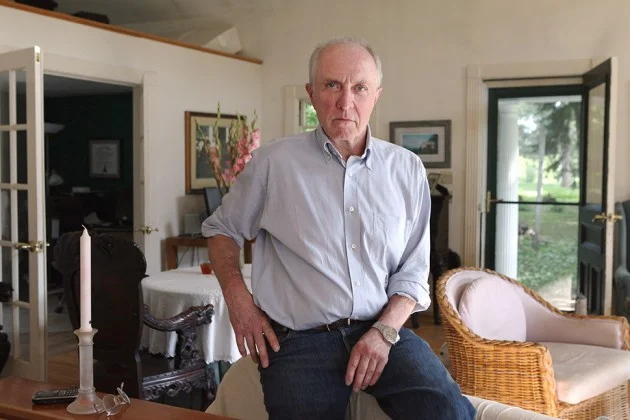
Until his Social Security check arrived nearly $300 lighter last June, Eric Merklein, 67, had no idea that he was carrying outstanding student debt. Merklein eventually learned that the government was taking money from his Social Security payments to repay loans he took out roughly four decades ago; he had thought they were paid. Merklein was unemployed, and the garnishment amounted to one-sixth of his total monthly income.
“‘You gotta be making this up,’” Merklein says he thought, at first. “The fact that they didn’t even call me or send me a postcard saying they were going to be doing this, I mean, it’s just nuts.”
Merklein is one of a growing number of Americans aged 50 and older who haven’t finished paying their student loans. Student debt is growing faster for seniors than for any other age group, according to the latest data gathered by the Federal Reserve Bank of New York.
Lingering student loan debt is part of a broader and, many elder-care lawyers say, devastating accumulation of debt among older Americans.
While people aged 50 and older hold only 17 percent of all U.S. student debt, this group has nearly three times as much debt as it did in 2005, according to the New York Fed data. By comparison, student debt for people under 40 is about one and a half times as high it was then.
The numbers don’t distinguish between older Americans who took out loans to finance their education and those who did so to put their children through college. A Gallup report released this month showed that people who took out loans decades ago are more likely to report low levels of health and financial well-being than their debt-free peers are.
For older Americans, owing for government-backed student loans can be particularly tough. Unlike other kinds of debt, including private student loans, collectors of federal student loan debt have the power to garnish income, block benefits, and withhold tax rebates. As a result, some older borrowers are seeing part of their Social Security payments seized and their wages cut off just when they are especially vulnerable.
Before Merklein went on Social Security in 2013, he was sure he didn’t have to worry about the money he borrowed from the government in 1970 to fund his undergraduate education. In the early 1970s, he says, his grandmother handed him an envelope with a note and a receipt that said the loan was paid in full. But Merklein lost the envelope—“I probably lost it within 48 hours, being a twentysomething at that time,” he says.
Now, nearly four decades after he went to college, the debt is haunting him. Merklein says that an agency collecting debt on the part of the government informed him that it has no record of the payment and that his loan accumulated interest for decades and went into default. He owed over $20,000, including collection costs, the agency said.
He spent hours speaking on the phone with debt collectors and says the government has stopped taking money out of his Social Security payments. He’s now paying $50 per month so that his loan can be transferred to a government repayment plan. He still worries about the Department of Education seizing his income without warning.
“They could come after me today,” he says. “And I would have no recourse.”
Garnishing social security checks is just one tactic the government can use to recoup money it is owed. Lawmakers gave federal officials far-reaching powers of debt collection two decades ago, after the largest federal loan guarantor collapsed and a congressional investigation revealed that schools were fraudulently receiving millions in federal grants.
Default rates have dropped by half since then, thanks in part to the government policies. But critics worry that the policies may also have crippled some who have no way to shake their debt, says Ben Miller, a senior policy analyst at the New America Foundation.
Some seniors are saddled with loan payments for an education that never led to stable employment. Debbie Crotinger, 55, borrowed around $10,000 to attend Garden City Community College in Garden City, Kans., in the early 1990s. She was going to college for the first time, fresh out of a marriage to a man she says was routinely abusive.
Bad Boys III
Martin Lawrence confirmed that a third Bad Boys movie is in development during an appearance on TBS' Conan Wednesday. "I just talked to [producer] Jerry Bruckheimer yesterday and he said it's real, they're working on the script, they're getting close, and it all looks good," the 49-year-old actor revealed.
Lawrence, who played Marcus in 1995's Bad Boys and 2003's Bad Boys II, did not reveal whether Will Smith will reprise his role. Still, it's hard to imagine anyone replacing Smith, Lawrence's partner in crime. He hinted at it, however, after Conan O'Brien asked to be given a walk-on role in the film. " I will mention it to will smith and Jerry Bruckheimer that Conan wants a cameo," Lawrence said with a smile.
"We wanna cast you in it," he said. "You know what you could play? A crooked cop on crack."
Conan laughed and shouted, "Yes! I think I was born to play that."
Lawrence first expressed interest in the movie last month. "11 years ago today, Bad Boys II was released in theaters. Feelin' it'' about time for number 3… what do you think Will Smith?" he wrote on Facebook July 18.
Earlier this year, Bruckheimer discussed the difficulties of getting a third Bad Boys movie made. "It's so funny because we'll get Sony real excited to make the movie, and then Will is off doing two movies. And then, Will will come back and be real excited about it, and Sony will say, 'Well, maybe it's not the time for this.' And then, Ride Along came out and was a big hit, and now they're all excited to make the movie, but Will is off doing something else. It's just trying to get everybody together to make it," he told Collider. "But, we're working on the script. We have a lot of faith and hope that we'll do it."

North West: The Model
Kanye 'Kardashian' West ranted last month:
“I want my daughter to have that opportunity to decide whether she wants to be famous or not. I think to myself, what the fuck am I going to do, how can I change it and how can I give my daughter her childhood?”
North West clearly has spoken at only 13 months and she wants to be a model. In the new issue of Carine Roitfeld's CR Fashion Book, the infant models a cashmere Chanel cardigan, tiny Chanel purse, flower broach and pearl earrings. North appears in a spread entitled "Legends," which celebrates unconventional style icons; beside her is a quote: "It's never too early to care about fashion!" - Karl Lagerfeld.

Patti LaBelle Joins 'American Horror Story: Freak Show'
She'll appear in four episodes of the FX anthology.
Patti LaBelle is bringing her "New Attitude" to FX's American Horror Story.
The Grammy Hall of Famer has booked a four-episode stint on the anthology series from Glee co-creators Ryan Murphy and Brad Falchuk, The Hollywood Reporter has confirmed.
Season four of the series, subtitled Freak Show, will focus on the last American freak show and be set in Jupiter, Fla., in the 1950s, with Jessica Lange in the lead role. This time, the Emmy winner will portray a German expat managing one of the last remaining freak shows in the country. Returning stars set for Freak Show include Lange, Kathy Bates, Angela Bassett, Frances Conroy, Sarah Paulson, Gabourey Sidibe and Evan Peters, among others, as well as AHS newcomers Michael Chiklis, The Hunger Games' Wes Bentley, Fargo's John Carroll-Lynch and The Normal Heart's Finn Wittrock. Chiklis is playing Bassett's husband and Bates' ex-husband.
As first reported by TV Line, LaBelle — who will not sing on the series — will play a local townie who begins to unravel the deadly secrets of Twisty the clown killer and the mother of Sidibe's character.
LaBelle becomes the second pop icon to appear on the series. Stevie Nicks guest starred as herself and appeared as two episodes on Coven, the witchy third installment of American Horror Story.
LaBelle is repped by Resolution. AHS: Freak Show debuts in October; a specific date has not yet been announced.

Robin William 1951 - 2014
Oscar-winning actor and comedian Robin Williams apparently took his own life at his Northern California home Monday, law enforcement officials said. Williams was 63.
"He has been battling severe depression of late," his media representative Mara Buxbaum told CNN. "This is a tragic and sudden loss. The family respectfully asks for their privacy as they grieve during this very difficult time."
Coroner investigators suspect "the death to be a suicide due to asphyxia," according to a statement from the Marin County, California, Sheriff's office.
Williams married graphic designer Susan Schneider in Napa Valley, California, ceremony in October 2011. Schneider sent a written statement to CNN through the representative.
"This morning, I lost my husband and my best friend, while the world lost one of its most beloved artists and beautiful human beings. I am utterly heartbroken.
"On behalf of Robin's family, we are asking for privacy during our time of profound grief. As he is remembered, it is our hope the focus will not be on Robin's death, but on the countless moments of joy and laughter he gave to millions."
Word of Williams' death stunned the entertainment community Monday.
Comedian Steve Martin tweeted, "I could not be more stunned by the loss of Robin Williams, mensch, great talent, acting partner, genuine soul."
Former CNN host Larry King said he would he remember Williams as "a genuine caring guy. Not just a funny man, but a guy who cared about people."
Marin County deputies responded to an emergency call from Williams' home in unincorporated Tiburon, California, at 11:55 a.m., reporting "a male adult had been located unconscious and not breathing," the release from the sheriff said.
Williams was pronounced dead at 12:02 p.m., it said.
Williams was last seen alive at his home, where he lives with his wife, at about 10 a.m., the sheriff's statement said.
"An investigation into the cause, manner and circumstances of the death is currently underway by the Investigations and Coroner Divisions of the Sheriff's Office," the sheriff's statement said.
"Coroner Division suspects the death to be a suicide due to asphyxia, but a comprehensive investigation must be completed before a final determination is made."
An autopsy is scheduled for Tuesday, the sheriff said.
Williams made at least two trips to rehab for drug treatment, including a visit this summer, and he underwent heart surgery in 2009.
Williams, born in Chicago on July 21, 1951, studied theater at Juilliard School before taking his stand up act to nightclubs. He was cast as Mork, an alien visitor to Earth, for a 1974 episode of television's "Happy Days."
The role led to the spin-off show "Mork & Mindy," which showcased Williams' usual comic improvisation talents.
He proved his dramatic acting skills in "Good Will Hunting," a 1997 film that earned him a best supporting actor Oscar.

Pro-Tip: ‘Expecting The Rapture’ No Excuse To Stop Teaching Homeschooled Kids.
A Texas court ruled this month that parents who allegedly stopped homeschooling their kids because they believed Jesus Christ was returning to Earth were not exempt from state education regulations.
According to a ruling last week by the Texas Eighth District Court of Appeals, Michael McIntyre and Laura McIntyre removed their nine children from a private school in 2004 to homeschool them.
Michael McIntyre’s twin brother, Tracy, testified that the parents used empty space in a motorcycle dealership that he co-owned as a classroom. But Tracy said that he never saw the children reading books, using computers or doing arithmetic. Instead, the children were seen playing instruments and singing.
“Tracy overhead one of the McIntyre children tell a cousin that they did not need to do schoolwork because they were going to be raptured,” the court document noted.
After Tracy confronted the parents about the curriculum, the school was later moved to a rental house.
In 2006, El Paso Independent School District met with the parents about an anonymous complaint that the children were not being educated. District attendance officer Mark Mendoza later confirmed that one of the daughters, Tori, had run away from home to “attend school,” and was enrolled at Coronado High School.
But when the district attempted to contact the McIntyres for curriculum information so that Tori could be properly placed at the school, the parents refused to cooperate.
Mendoza filed truancy complaints against the McIntyres in 2007, and the couple filed suit for injunctive relief based on Texas Education Code, the Texas Religious Freedom Restoration Act (TRFRA), the Texas Constitution, and the United States Constitution.
The appeals court ruled that educational regulations did not prevent the McIntyres’ First Amendment right to “free exercise of religion.” The court said that 1972 court case which found that Amish did not have to send their children to school after the eighth grade did not exempt the McIntyres.
“No parents have ever prevailed in any reported case on a theory that they have an absolute constitutional right to educate their children in the home, completely free of any state supervision, regulation, or requirements,” the ruling stated. “They do not have an ‘absolute constitutional right to home school.’”

Yelp Reviewers Want to be Paid
LOS ANGELES (CN) - Reviewers sued Yelp in a federal class action, claiming the online review service owes them wages and expenses for doing "the exact same work" that Yelp's paid employees do.
Lead plaintiff Lily Jeung claims that she and the putative class "perform the exact same work" posting reviews as many of Yelp's paid workers perform, but they aren't paid a dime for it.
"This is a lawsuit merely to provide the wages to all writers of Yelp and not just the ones which Yelp, Inc. chooses to pay in wages," the complaint states.
It's the second class action complaint against Yelp this week in California courts. On Wednesday, shareholders accused its top three executives of dumping more than $20 million of their own shares at prices inflated by false and misleading statements.
Jeung et al. are represented by Daniel Bernath, of Tigard, Or
Paleontologists startled to find 2-meter penguin, biggest ever found Palaeeudyptes klekowskii, fondly dubbed the 'Colossus'
Penguins are adorable – their tuxedo plumage, their precious waddle with their little vestigial wings balancing them, their charming fluffy chicks resting on daddy's scaly clawed feet. You look down at them and smile.
Now imagine one looking down at you. Wonder if he'd think you were cute. Fossil penguins that was nearly seven feet long and almost certainly taller than you have been discovered on the Antarctic Peninsula by Argentine paleontologists, who dubbed the extinct bird 'Colossus' by virtue of its awesome proportions.
More formally known as Palaeeudyptes klekowskii, it is the largest-known penguin ever to have walked the earth.
It bears elaboration that penguins aren't measured by "height," but by "length," because of their posture. Their height is somewhat lesser than their length from beak-tip to toes. In the case of Colossus, its beak was mighty long. But unless you're NBA material, it towered over you.
Experts had known that giant penguins had existed, says paleontologist Carolina Acosta Hospitaleche, who works at the La Plata Museum. They just hadn't thought they got that big.
The breakthrough was when Acosta Hospitaleche found an astonishingly large tarsometatarsus - a fused ankle-foot bone - that spanned 9.1 centimeters on Seymour Island. It was the biggest ever found, and from it she extrapolated that the bird was a hair over two meters long, from beak-tip to toe.
The biggest contemporary penguin is the Emperor, which is pretty hefty – it can max out at a height of 130 centimeters. Colossus was three feet taller and weighed twice as much as the Emperor, around 250 pounds, say the scientists.
Sad to say it went extinct some 35 million years ago, a time when the region was somewhat warmer, rather like the tip of South America today. The Colossus was one of many species – about ten, or 14, depending on classifications by squabbling paleontologists - of penguin on Seymour Island.
Modern-day penguins swim beautifully but Colossus had stamina that beat the lot, able to stay underwater for 40 minutes at a stretch, says the team from Argentina's Museum of Natural Science. Yet they went extinct.
All of this begs a question about latter-day penguins. The birds are famous for preferring cold climes. What will happen to them in the changing, warmer world? Some scientists believe they may survive through adaptation, based on evidence that colonies thought to have disappeared had actually simply upped and moved.
Big Foot is on vacation in Lake Tahoe w/video
A Lake Tahoe, California, man out on a long boarding ride recently is getting attention for what he says he captured on video: Bigfoot.
So did you catch it? Go back and look around the four-second mark and then again at nine-second mark. On the very left side of the screen, a shadowy figure appears. That, folks, is what he’s calling Bigfoot.
Here’s what he’s talking about:

It’s hard to believe, but that’s it. Other possible explanations: a tree, a shadow, a bear, an optical illusion or of course a hoax.
Cryptozoology News, which is a website that documents the paranormal, noted the breakdown from the YouTube channel that published the video (originally sent by a user who goes by the name “Couch Potato”).
“The dark area in the bush was something that we noticed. Couch Potato didn’t say anything about it when he contacted us. I don’t know if it is the supposed creature or not. Who knows if it is legitimate or not,” the owner of the YouTube channel The Paranormal Review told said in a separate video. “He says it is a GoPro that he got the video with, so it would be pretty wide angle and I can understand him not seeing the thing that is there until looking later.”
He continued, addressing the hoax possibility:
“Whether or not that’s true, I don’t know, this could be a hoax, but most hoax videos we have seen in the past…they are looking at this creature for like 20 seconds and they are just standing there ‘what is this, what is this”. In this case, they are not trying to draw attention to it, it’s just standing there for a brief second…so that makes me believe that is not a hoax,” he said about the footage. “I don’t think it’s a bear, it doesn’t look like a bear to me.”
Here’s the breakdown, which has plenty of skepticism (but also says it’s either “real” or a “misidentification”):

A Brazilian man is buying all the records in the world
Paul Mawhinney, a former music-store owner in Pittsburgh, spent more than 40 years amassing a collection of some three million LPs and 45s, many of them bargain-bin rejects that had been thoroughly forgotten. The world’s indifference, he believed, made even the most neglected records precious: music that hadn’t been transferred to digital files would vanish forever unless someone bought his collection and preserved it.
Mawhinney spent about two decades trying to find someone who agreed. He struck a deal for $28.5 million in the late 1990s with the Internet retailer CDNow, he says, but the sale of his collection fell through when the dot-com bubble started to quiver. He contacted the Library of Congress, but negotiations fizzled. In 2008 he auctioned the collection on eBay for $3,002,150, but the winning bidder turned out to be an unsuspecting Irishman who said his account had been hacked.
Then last year, a friend of Mawhinney’s pointed him toward a classified ad in the back of Billboard magazine:
RECORD COLLECTIONS. We BUY any record collection. Any style of music. We pay HIGHER prices than anyone else.
That fall, eight empty semitrailers, each 53 feet long, arrived outside Mawhinney’s warehouse in Pittsburgh. The convoy left, heavy with vinyl. Mawhinney never met the buyer.
“I don’t know a thing about him — nothing,” Mawhinney told me. “I just know all the records were shipped to Brazil.”
Just weeks before, Murray Gershenz, one of the most celebrated collectors on the West Coast and owner of the Music Man Murray record store in Los Angeles, died at 91. For years, he, too, had been shopping his collection around, hoping it might end up in a museum or a public library. “That hasn’t worked out,” The Los Angeles Times reported in 2010, “so his next stop could be the Dumpster.” But in his final months, Gershenz agreed to sell his entire collection to an anonymous buyer. “A man came in with money, enough money,” his son, Irving, told The New York Times. “And it seemed like he was going to give it a good home.”
Those records, too, were shipped to Brazil. So were the inventories of several iconic music stores, including Colony Records, that glorious mess of LP bins and sheet-music racks that was a Times Square landmark for 64 years. The store closed its doors for good in the fall of 2012, but every single record left in the building — about 200,000 in all — ended up with a single collector, a man driven to get his hands on all the records in the world.
In an office near the back of his 25,000-square-foot warehouse in São Paulo, Zero Freitas, 62, slipped into a chair, grabbed one of the LPs stacked on a table and examined its track list. He wore wire-rimmed glasses, khaki shorts and a Hard Rock Cafe T-shirt; his gray hair was thin on top but curled along his collar in the back. Studying the song list, he appeared vaguely professorial. In truth, Freitas is a wealthy businessman who, since he was a child, has been unable to stop buying records. “I’ve gone to therapy for 40 years to try to explain this to myself,” he said.
Continue reading the main story
His compulsion to buy records, he says, is tied up in childhood memories: a hi-fi stereo his father bought when Freitas was 5 and the 200 albums the seller threw in as part of the deal. Freitas was an adolescent in December 1964 when he bought his first record, a new release: “Roberto Carlos Sings to the Children,” by a singer who would go on to become one of Brazil’s most popular recording stars. By the time he finished high school, Freitas owned roughly 3,000 records.
After studying music composition in college, he took over the family business, a private bus line that serves the São Paulo suburbs. By age 30, he had about 30,000 records. About 10 years later, his bus company expanded, making him rich. Not long after that, he split up with his wife, and the pace of his buying exploded. “Maybe it’s because I was alone,” Freitas said. “I don’t know.” He soon had a collection in the six figures; his best guess at a current total is several million albums.
Recently, Freitas hired a dozen college interns to help him bring some logic to his obsession. In the warehouse office, seven of them were busy at individual workstations; one reached into a crate of LPs marked “PW #1,425” and fished out a record. She removed the disc from its sleeve and cleaned the vinyl with a soft cloth before handing the album to the young man next to her. He ducked into a black-curtained booth and snapped a picture of the cover. Eventually the record made its way through the assembly line of interns, and its information was logged into a computer database. An intern typed the name of the artist (the Animals), the title (“Animalism”), year of release (1966), record label (MGM) and — referencing the tag on the crate the record was pulled from — noted that it once belonged to Paulette Weiss, a New York music critic whose collection of 4,000 albums Freitas recently purchased.
The interns can collectively catalog about 500 records per day — a Sisyphean rate, as it happens, because Freitas has been burying them with new acquisitions. Between June and November of last year, more than a dozen 40-foot-long shipping containers arrived, each holding more than 100,000 newly purchased records. Though the warehouse was originally the home of his second business — a company that provides sound and lighting systems for rock concerts and other big events — these days the sound boards and light booms are far outnumbered by the vinyl.
Many of the records come from a team of international scouts Freitas employs to negotiate his deals. They’re scattered across the globe — New York, Mexico City, South Africa, Nigeria, Cairo. The brassy jazz the interns were listening to on the office turntable was from his man in Havana, who so far has shipped him about 100,000 Cuban albums — close to everything ever recorded there, Freitas estimated. He and the interns joke that the island is rising in the Caribbean because of all the weight Freitas has hauled away.
Allan Bastos, who for years has served as Freitas’s New York buyer, was visiting São Paulo and joined us that afternoon in the warehouse office. Bastos, a Brazilian who studied business at the University of Michigan, used to collect records himself, often posting them for sale on eBay. In 2006, he noticed that a single buyer — Freitas — was snapping up virtually every record he listed. He has been buying records for him ever since, focusing on U.S. collections. He has purchased stockpiles from aging record executives and retired music critics, as well as from the occasional celebrity (he bought the record collection of Bob Hope from his daughter about 10 years after Hope died). This summer Bastos moved to Paris, where he’ll buy European records for Freitas.
Continue reading the main story
Bastos looked over the shoulder of an intern, who was entering the information from another album into the computer.
“This will take years and years,” Bastos said of the cataloging effort. “Probably 20 years, I guess.”
Twenty years — if Freitas stops buying records.
Collecting has always been a solitary pursuit for Freitas, and one he keeps to himself. When he bought the remaining stock of the legendary Modern Sound record store in Rio de Janeiro a couple of years ago, a Brazilian newspaper reported that the buyer was a Japanese collector — an identity Bastos invented to protect Freitas’s anonymity. His collection hasn’t been publicized, even within Brazil. Few of his fellow vinyl enthusiasts are aware of the extent of his holdings, partly because Freitas never listed any of his records for sale.
But in 2012, Bob George, a music archivist in New York, traveled with Bastos to São Paulo to prepare for Brazilian World Music Day, a celebration that George organized, and together they visited Freitas’s home and warehouse; the breadth of the collection astonished George. He was reminded of William Randolph Hearst, the newspaper magnate who lusted after seemingly every piece of art on the world market and then kept expanding his private castle to house all of it.
“What’s the good of having it,” George remembers telling Freitas, “if you can’t do something with it or share it?”
The question nagged at Freitas. For the truly compulsive hobbyist, there comes a time when a collection gathers weight — metaphysical, existential weight. It becomes as much a source of anxiety as of joy. Freitas in recent years had become increasingly attracted to mystic traditions — Jewish, Christian, Hindu, Buddhist. In his house, he and his second wife created a meditation room, and they began taking spiritual vacations to India and Egypt. But the teachings he admired didn’t always jibe with his life as a collector — acquiring, possessing, never letting go. Every new record he bought seemed to whisper in his ear: What, ultimately, do you want to do with all this stuff?
He found a possible model in George, who in 1985 converted his private collection of some 47,000 records into a publicly accessible resource called the ARChive of Contemporary Music. That collection has grown to include roughly 2.2 million tapes, records and compact discs. Musicologists, record companies and filmmakers regularly consult the nonprofit archive seeking hard-to-find songs. In 2009 George entered into a partnership with Columbia University, and his archive has attracted support from many musicians, who donate recordings, money or both. The Rolling Stones guitarist Keith Richards has provided funding for the archive’s collection of early blues recordings. David Bowie, Paul Simon, Nile Rodgers, Martin Scorsese and Jonathan Demme all sit on its board.
Freitas has recently begun preparing his warehouse for his own venture, which he has dubbed Emporium Musical. Last year, he got federal authorization to import used records — an activity that hadn’t been explicitly allowed by Brazilian trade officials until now. Once the archive is registered as a nonprofit, Freitas will shift his collection over to the Emporium. Eventually he envisions it as a sort of library, with listening stations set up among the thousands of shelves. If he has duplicate copies of records, patrons will be able to check out copies to take home.
Continue reading the main story
Some of those records are highly valuable. In Freitas’s living room, a coffee table was covered with recently acquired rarities. On top of a stack of 45s sat “Barbie,” a 1962 single by Kenny and the Cadets, a short-lived group featuring the Beach Boys’ Brian Wilson on lead vocals and, as backup singers, Wilson’s brother Carl and their mother, Audree. In the same stack was another single — “Heartache Souvenirs"/"Chicken Shack,” by William Powell — that has fetched as much as $5,000 on eBay. Nearby sat a Cuban album by Ivette Hernandez, a pianist who left Cuba after Fidel Castro took power; Hernandez’s likeness on the cover was emblazoned with a bold black stamp that read, in Spanish, “Traitor to the Cuban Revolution.”
While Freitas thumbed through those records, Bastos was warning of a future in which some music might disappear unnoticed. Most of the American and British records Freitas has collected have already been digitally preserved. But in countries like Brazil, Cuba and Nigeria, Bastos estimated, up to 80 percent of recorded music from the mid-20th century has never been transferred. In many places, he said, vinyl is it, and it’s increasingly hard to find. Freitas slumped, then covered his face with his hands and emitted a low, rumbling groan. “It’s very important to save this,” he said. “Very important.”
Freitas is negotiating a deal to purchase and digitize thousands of Brazilian 78 r.p.m. recordings, many of which date to the early 1900s, and he expects to digitize some of the rarest records in his collection shortly thereafter. But he said he could more effectively save the music by protecting the existing vinyl originals in a secure, fireproof facility. “Vinyl is very durable,” he said. “If you store them vertically, out of the sun, in a temperature-controlled environment, they can pretty much last forever. They aren’t like compact discs, which are actually very fragile.”
In his quest to save obscure music, Bastos told me, Freitas sometimes buys records he doesn’t realize he already owns. This spring he finally acquiesced to Bastos’s pleas to sell some of his duplicate records, which make up as much as 30 percent of his total collection, online.
“I said, ‘Come on, you have 10 copies of the same album — let’s sell four or five!’ ” Bastos said.
Freitas smiled and shrugged. “Yes, but all of those 10 copies are different,” he countered. Then he chuckled, as if recognizing how illogical his position might sound.
In March, he began boxing up 10,000 copies of Brazilian LPs to send to George in an exchange between the emerging public archive and its inspirational model. It was a modest first step, but significant. Freitas had begun to let go.
Earlier this year, Freitas and Bastos stopped into Eric Discos, a used-record store in São Paulo that Freitas frequents. “I put some things aside for you,” the owner, Eric Crauford, told him. The men walked next door, where Crauford lives. Hundreds of records and dozens of CDs teetered in precarious stacks — jazz, heavy metal, pop, easy listening — all for Freitas.
Continue reading the main story Continue reading the main story
Sometimes Freitas seems ashamed of his own eclecticism. “A real collector,” he told me, is someone who targets specific records, or sticks to a particular genre. But Freitas hates to filter his purchases. Bastos once stumbled upon an appealing collection that came with 15,000 polka albums. He called Freitas to see if it was a deal breaker. “Zero was asking me about specific polka artists, whether they were in the collection or not,” Bastos remembered. “He has this amazing knowledge of every kind of music.”
That afternoon, Freitas purchased Crauford’s selections without inspecting them, as he always does. He told Crauford he’d send someone later in the week to pick them up and deliver them to his house. Bastos listened to the exchange without comment but noted the destination of the records — Freitas’s residence, not the archive’s warehouse. He was worried that the collector’s compulsions might be getting in the way of the archiving efforts. “Zero isn’t taking too many of the records to his house, is he?” Bastos had asked a woman who helps Freitas manage his cataloging operation.
No, she told him. But almost every time Freitas picked up a record at the archive, he’d tell a whole story about it. Often, she said, he’d become overwhelmed with emotion. “It’s like he almost cries with every record he sees,” she told him.
Freitas’s desire to own all the music in the world is clearly tangled up in something that, even after all these years, remains tender and raw. Maybe it’s the nostalgia triggered by the songs on that first Roberto Carlos album he bought, or perhaps it stretches back to the 200 albums his parents kept when he was small — a microcollection that was damaged in a flood long ago but that, as an adult, he painstakingly recreated, album by album.
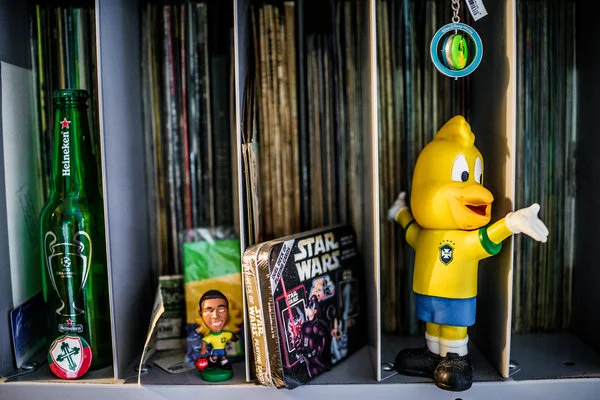
After the trip to Eric Discos, I descended into Freitas’s basement, where he keeps a few thousand cherry-picked records, a private stash he doesn’t share with the archive. Aside from a little area reserved for a half-assembled drum kit, a couple of guitars, keyboards and amps, the room was a labyrinth of floor-to-ceiling shelving units filled with records.
He walked deep into an aisle in search of the first LP he ever bought, the 1964 Roberto Carlos record. He pulled it from the shelf, turning it slowly in his hands, staring at the cover as if it were an irreplaceable artifact — as if he did not, in fact, own 1,793 additional copies of albums by Roberto Carlos, the artist who always has, and always will, occupy more space in his collection than anyone else.
Nearby sat a box of records he hadn’t shelved yet. They came from the collection of a man named Paulo Santos, a Brazilian jazz critic and D.J. who lived in Washington during the 1950s and who was friendly with some of the giants of jazz and modern classical music. Freitas thumbed through one album after another — Duke Ellington, Ella Fitzgerald, Leonard Bernstein, Dave Brubeck. The records were signed, and not with simple autographs; the artists had written affectionate messages to Santos, a man they obviously respected.
“These dedications are so personal,” Freitas said, almost whispering.
He held the Ellington record for an extended moment, reading the inscription, then scanning the liner notes. Behind his glasses, his eyes looked slightly red and watery, as if something was irritating them. Dust, maybe. But the record was perfectly clean.
Breaking Bad spinoff Better Call Saul
Short clip, which aired over the weekend, shows Bob Odenkirk as Breaking Bad’s errant lawyer Saul Goodman in discussion with a client.
It’s barely enough to satisfy the craving, but Breaking Bad fans have been given a small fix in the form of a nine-second teaser for forthcoming spinoff Better Call Saul.
The clip, which aired on AMC in the US over the weekend, shows Bob Odenkirk’s errant lawyer Saul Goodman addressing a client: “Lawyers, we’re like health insurance. You hope you never need it, but man oh man, not having it? No.” Keen Breaking Bad viewers will notice that Goodman’s hair has more thickness to it than usual.
In July, a billboard appeared in Albuquerque advertising the services of “James M McGill”, Goodman’s alter ego as a younger man. Callers to the number given could hear Odenkirk’s voice on an answerphone message.
The teaser clip ends with a promised air date of February 2015. The show will air on Netflix in the UK.
Sunday Mass - Bad Brains Live at CBGB's 1982 [FULL CONCERT]
Washington D.C. Tops Forbes 2014 List of America's Coolest Cities

Flooded with politicos and political junkies, Washington, D.C., often comes off as a city steeped in raw ambition. But the nation’s capital deserves to be known for something else: coolness.
While “cool” might not be the first word that comes to mind when contemplating the latest standoff in Congress, D.C. nonetheless has a lot to offer those who call it home. Among its best features: abundant entertainment and recreational options, an ethnically and culturally diverse population, and a big chunk of people age 20 to 34–nearly 30% of the metro area’s population. There’s certainly plenty to do, from visiting the many museums along the National Mall to taking in a Washington Nationals game to simply enjoying the cherry blossoms in springtime.
“D.C. is a high-amenity city. It has its share of cultural arts. It has its share of natural beauty,” says Stuart Gabriel, Director of the Ziman Center for Real Estate at the UCLA Anderson School of Management.
Add the city’s constantly refreshing population–the metro area has grown by 4.9% since 2010 thanks to net migration alone–and Washington, D.C., holds the perfect formula to land the No. 1 spot on Forbes’ list of America’s Coolest Cities. And by “cool,” we mean cool to live in.
Behind the Numbers
How do you define “cool”? Clearly, one person’s definition–all-night World of Warcraft sessions, say–could be another person’s total dorkdom. We sought to quantify it in terms of cities, partnering with Sperling’s BestPlaces to rank the 60 largest Metropolitan Statistical Areas and Metropolitan Divisions (cities and their surrounding suburbs, as defined by the U.S. Office of Management and Budget) based on six data points we weighted evenly. (Orlando, unfortunately, had to be excluded due to a problem with its data.)
To compile our list of America’s Coolest Cities, Sperling’s helped us calculate entertainment options per capita in each metro area. This metric essentially measures ways you might spend a Saturday, quantifying the availability of professional and college sports events, zoos and aquariums, golf courses, ski areas, and National parks, among others. It also factors in art and cultural options, measuring the presence of theater and musical performances as well as local museums.