
Proof Jenny McCarthy is evil.......the real toll of anti-vaccination

The toll of the anti-vaccination movement, in one devastating graphic

la-fi-mh-antivaccination-movement-20140120-001.jpg

Aaron Carroll today offers a graphic depiction of the toll of the anti-vaccination movement. (H/t: Kevin Drum.) It comes from a Council on Foreign Relations interactive map of "vaccine-preventable outbreaks" worldwide 2008-2014.

A couple of manifestations stand out. One is the prevalence of measles in Europe -- especially Britain -- and the U.S. Measles is endemic in the underdeveloped world because of the unavailability of the MMR (measles, mumps and rubella) vaccine.

But in the developed world it's an artifact of the anti-vaccination movement, which has associated the vaccine with autism. That connection, promoted by the discredited British physician Andrew Wakefield and the starlet Jenny McCarthy, has been thoroughly debunked. But its effects live on, as the map shows.

Vaccine panic also plays a role in the shocking incidence in the U.S. of whooping cough, also beatable by a common vaccine. Researchers have pointed to the effect of "non-medical exemptions" from legally required whooping cough immunizations -- those premised on personal beliefs rather than medical reasons -- as a factor in a 2010 outbreak of whooping cough in California.

These manifestations underscore the folly and irresponsibility of giving credence to anti-vaccination  fanatics, as Katie Couric did on her network daytime TV show in December. We examined the ethics of that ratings stunt here and here.

Among other worthwhile examinations of the impact of the anti-vaxxers, see this piece about growing up unvaccinated in Great Britain in the 1970s, and this disturbing piece by Julia Ioffe about her battle with whooping cough, a disease no American should have.

The lesson of all this is that vaccination is not an individual choice to be made by a parent for his or her own offspring. It's a public health issue, because the diseases contracted by unvaccinated children are a threat to the community. That's what public health is all about, and an overly tolerant approach to non-medical exemptions -- and publicity given to anti-vaccination charlatans like Wakefield and McCarthy by heedless promoters like, sadly, Katie Couric, affect us all.

Carroll, who assembles the relevant papers and documents on the MMR/Autism sophistry here, deserves the last word. "Vaccinate your kids," he writes. "Please."


Via LATimes

Source: http://www.latimes.com/business/hiltzik/la...

Federal judge sent hundreds of racist messages

.........Appointed by Bush, you dont say........

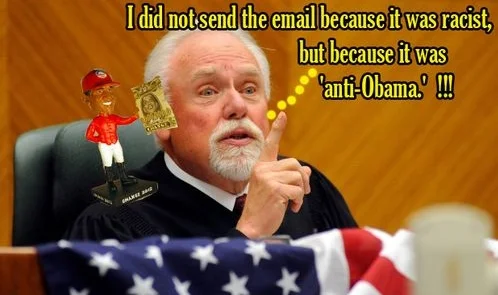
Last year, U.S. District Chief Judge Richard Cebull, an appointee of George W. Bush, was caught sending a racist email about President Obama from his courthouse chambers. At the time, Cebull, Montana’s chief federal judge for nearly five years, defended himself by saying the message “was not intended by me in any way to become public.”


It wasn’t long before the Judicial Council of the U.S. 9th Circuit Court of Appeals opened a misconduct review, and on Friday, we learned that Cebull kept awfully busy disseminating offensive messages to his personal and professional contacts. The Associated Press reported over the weekend:

A former Montana judge who was investigated for forwarding a racist email involving President Barack Obama sent hundreds of other inappropriate messages from his federal email account, according to the findings of a judicial review panel released Friday.


Former U.S. District Judge Richard Cebull sent emails to personal and professional contacts that showed disdain for blacks, Indians, Hispanics, women, certain religious faiths, liberal political leaders, and some emails contained inappropriate jokes about sexual orientation, the Judicial Council of the 9th U.S. Circuit Court of Appeals found.


Many of the emails also related to pending issues that could have come before Cebull’s court, such as immigration, gun control, civil rights, health care and environmental issues, the council found in its March 15, 2013, order.

In case it’s not obvious, it’s critically important for federal judges to maintain a sense of credibility and impartiality. Once a jurist is exposed as a bigot, he or she can no longer expect to rule from the bench.


In Cebull’s case, the 9th Circuit was not lenient.


The panel issued a public reprimand, instructed that the judge receive no new cases for 180 days, ordered him to complete  new round of judicial training, and told the judge he must issue an apology that acknowledged “the breadth of his behavior.”


Judicial impeachment was ruled out because he was not found to have violated any state or federal laws.


All of this, however, happened 10 months ago. Why didn’t we hear anything until now? Because Cebull resigned the same month as he received the judicial council’s report, making the sanctions moot.


That said, Judge Theodore McKee, the chief judge of the 3rd U.S. Circuit, petitioned the panel, arguing that the judicial council’s work should be made public. The committee agreed.


“The imperative of transparency of the complaint process compels publication of orders finding judicial misconduct,” the national judicial panel wrote in its decision.


VIA MSNBC

Source: http://www.msnbc.com/rachel-maddow-show/fe...

It's Not Too Late to Make San Francisco Affordable Again. Here's How

San Francisco, is in the midst of an affordability crisis. People here are angry and afraid. The skyrocketing cost of housing comes up in seemingly every conversation and dominates local news and local politics.

The recent piece on San Francisco's housing crisis I wrote for The Atlantic Cities seemed to hit a nerve. But it was mostly devoted to describing how the city got to be a place with the highest housing costs in the country. Now, I want to turn to what we can actually do about it.

We face a complex problem. It has roots in income inequality, a national issue, as well as regional anti-growth attitudes that extend well beyond the city boundaries. But at the city level, there are a surprising number of things we can definitely do.

Protect existing rent-controlled housing units

San Francisco has roughly 172,000 units of rent-controlled housing. Rent control is the city's core tenant protection, allowing many people to stay here. The first thing the city needs to do is to make sure we don't lose those units.

As housing prices go up, there is ever more incentive for owners of rental units to find a way to get out of the landlord business and sell. One of the most often abused mechanisms is California’s Ellis Act, a state law that says that landlords have the unconditional right to evict tenants to "go out of business."

Tenant groups in San Francisco have developed a set of proposals to make it more difficult for landlords to use the Ellis Act as a tool to evict people. One of the proposed reforms that seems to make sense is to discourage the practice of buying rent-controlled units for the purpose of converting to Tenancy-in-common units (TICs) or condos by requiring landlords to have been in the landlord business for some set period of time before using the Ellis Act to “leave the business.”

images.jpg

There is a social compact in San Francisco that needs to be upheld: rent-controlled units should stay under rent control, while ownership opportunities should come from new construction.

Reinvest in San Francisco’s public housing stock

The San Francisco Housing Authority has 6,300 units of public housing and roughly 9,000 Section 8 vouchers (which help subsidize rents for low-income tenants). The city is in the process of compiling a broad public housing reform plan to better manage this housing stock and provide resources to upgrade many of its public housing buildings.

At the same time, the city is also working on an ambitious program to rehabilitate its most troubled public housing units as part of a program called HOPE SF. Through Hope SF, the city government is seeking to build in a comprehensive set of social services to give residents the resources to get out of poverty. San Francisco has started this process by identifying the highest-need public housing developments (such as those at Sunnydale and Potrero Terrace), pairing them with project sponsor teams, but much of the funding for both the redevelopment and the resident services still needs to be identified.

HOPE SF and the broader set of public housing renovations offer an opportunity to physically knit public housing back into the fabric of the city. But most importantly, it means we can keep all those affordable units habitable.

More here Via The Atlantic

Source: http://www.theatlanticcities.com/housing/2...

The Decline of the American Book Lover

And why the downturn might be over.

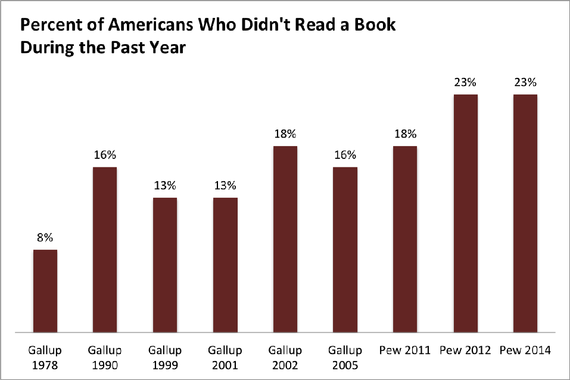
The Pew Research Center reported last week that nearly a quarter of American adults had not read a single book in the past year. As in, they hadn't cracked a paperback, fired up a Kindle, or even hit play on an audiobook while in the car. The number of non-book-readers has nearly tripled since 1978.
If you are the sort of person who believes that TV and the Internet have turned American culture into a post-literate scrubland full of cat GIFs and reality TV spinoffs, then this news will probably reinforce your worst suspicions. But buried beneath it, I think there's an optimistic story to tell about American book culture. It's about the kids. 
Without question, the American bookworm is a rarer species than two or three decades ago, when we didn't enjoy today's abundance of highly distracting gadgets. In 1978, Gallup found that 42 percent of adults had read 11 books or more in the past year (13 percent said they'd read more than 50!).  Today, Pew finds that just 28 percent hit the 11 mark. 
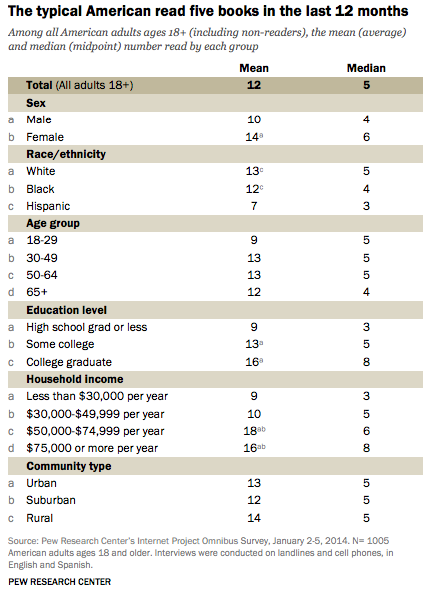
But here's why I wouldn't proclaim the death of the book quite yet (aside from the fact that the vast majority of the country does still read them).First, as shown on the Pew chart below, the number of books an American reads tends to be closely associated with his or her level of education. Even those with just a little bit of college read far more, on average, than men and women who only finished high school. That may be because people who grow up reading are far more likely to enroll in higher education. But it seems at least somewhat likely that reading books in class conditions people to read books later in life. And the good news (for publishers, at least) is that today's twenty-somethings, as a rule, go to college. A recent Department of Education study found that 85 percent of the high-school class of 2004 had at least some postsecondary education. 

It's true that those highly educated young adults aren't reading that many books today. The average 18-to-29 year old finishes nine per year, compared to 13 among older American. But according to the National Endowment for the Arts, teens and twenty-somethings have almost always read less than older adults.

Most importantly, the percentage of young folks reading for pleasure stopped declining. Last year, the NEA found that 52 percent of 18-24 year-olds had read a book outside of work or school, the same as in the pre-Facebook days of 2002. If book culture were in terminal decline, this is the demographic where you'd expect it to be fading fastest. Perhaps the worst of the fall is over. 

Source: http://www.theatlantic.com/business/archiv...

What's in Those Haribo Gummy Bears?

The science of lycasin, destroyer of worlds, intestines

5bde878b8.jpg

In all fairness, you were warned. The Amazon description for sugar-free Haribo Gummy Bears reads, in part: "This product is a sugarless/sugarfree item with ingredients that can cause intestinal distress if eaten in excess."

"Intestinal distress," in this case, might be an understatement for what a series of viral Amazon reviews call, "trumpets calling the demons back to Hell," "guttural pronouncement so loud it threatened to drown out my own voice," and "100% liquid. Flammable liquid. NAPALM."

So why is it that gummy bears, an otherwise delicious, springy snack, become so sphincter-confounding once the sugar is removed?

A glance at the nutrition panel shows that the first (and thus most prevalent) ingredient in the sugar-free variety is lycasin, a hydrogenated syrup. Lycasin, meanwhile, consists mainly of maltitol, a sugar alcohol that is almost as sweet as table sugar but half as caloric. Maltitol is great because it doesn't cause cavities, but not so great because our bodies can't fully digest it, so it can ferment in the gut. The known side effects of the excessive consumption of lycasin are bloating, flatulence, loose stools, and borborygmi, the scientific term for tummy-rumbling. 

Via The Atlantic

Though the substance is considered safe to eat, in clinical studies, adults who consumed 40 grams of lycasin saw an increased frequency of bowel movements and "watery feces." The gummy bears in question come in bags of 5 pounds, otherwise known as 2,267 grams, otherwise known as a world of hurt.

Of course, this also means you now have the perfect hate-gift for your foes:

"I bought one order for the Westboro Baptist Church as a donation," one Amazon reviewer wrote. "Because we all know how much God hates irregularity."

Otherwise, this might be a time to indulge your sweet tooth with actual sugar.

Source: http://www.theatlantic.com/health/archive/...

The Night Misguided Justin Bieber Fans Turned To EL-P For Support

JUSTIN-BIEBER.jpg
el-p.jpg

VIA PigeonsandPlanes.com: Yesterday, police raided Justin Bieber’s house after an incident last week in which the singer allegedly egged a neighbor’s house. According to TMZ, the LAPD served the 19-year-old with a search warrant for anything relating to the dubious egg-throwing, which frankly doesn’t make any fucking sense because besides the eggs that were thrown, what other kind of evidence is involved with egging someone’s house? Maybe like a plan of action scribbled down on a Taco Bell wrapper? I don’t know, at this point I’m exhausted by Bieber’s life but he keeps popping up, so here we are.

Anyways, during the raid, police found what they now believe is molly belonging to Justin’s close friend Lil Za and Za was consequently arrested yesterday morning for drug possession. This whole ordeal obviously sparked a lot of reaction from the Twitter community, but out of the sea of those making jokes about pretty much anything having to do with this, an unlikely voice emerged: El-P. The rapper Tweeted his disapproval for the need to use law enforcement for something as stupid as egging someone’s house; and while his point is understandable, many young Beliebers looking for a voice of reason took this mistakenly as the rapper defending Bieber. How they found El, no one knows but once they did they followed, retweeted, and praised. In droves. The result was hours of El-P hilariously dealing with Beliebers in a way only El-P could. So turn on Cancer 4 Cure and enjoy.

See the tweets HERE.

Source: http://pigeonsandplanes.com/2014/01/el-p-j...