DC Park:11th Street Bridge

image.jpg

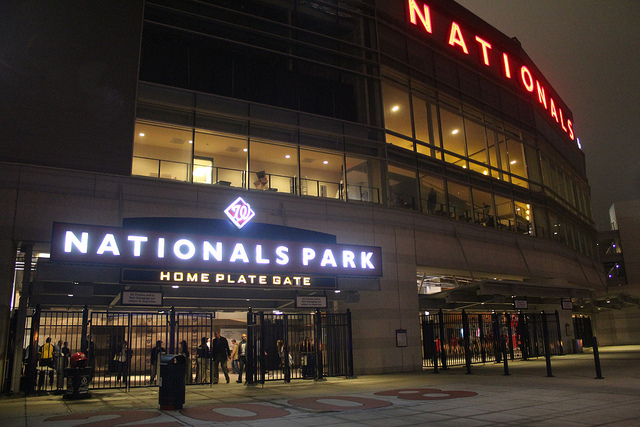
The subject of Washington’s buzziest architecture competition isn’t a Smithsonian museum or a downtown office building, but a series of concrete piers jutting out of the Anacostia River a dozen blocks east of Nationals Park.

More than 40 architecture teams comprised of 82 firms initially expressed interested in designing a park traversing the Anacostia  – what could become a local version of New York’s High Line Park — atop piers that held up the old 11th Street Bridge before it was replaced.

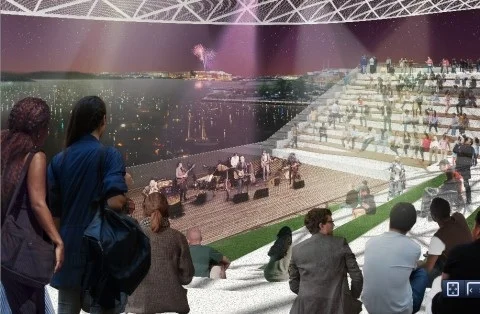
The four finalists submitted their proposals to the project’s organizers Tuesday, and they leave nothing to the imagination: there are amphitheaters, education centers, dining piers, urban gardens, waterfalls, climbing walls and an array of eye-catching architectural features, any of which could transform the old bridge site into a distinctive landmark.

Scott Kratz, director of the 11th Street Bridge Park, said the project has the chance to bring needed attention to a river that has suffered environmentally and long served as a barrier between the majority of the city and some of its poorest communities. He said he was thrilled at the quality of responses.

“These are some of the best designers in the world and their work reflects that,” he said. “We were hoping that the proposals would not just be shades of gray and we received reds and blues and greens and purples. They are all so different while still responding to the community’s vision.”

The teams will come to Washington to present their ideas to a jury of experts in design, architecture, health and economic development on Sept. 29-30 and a final decision is expected Oct. 16.

Whoever is named the project’s designer will do so with a caveat, as some $40 million needs to be raised to build and operate the park. The project is a collaboration between the D.C. government and the non-profit Building Bridges Across the River, and already the D.C. government has committed to providing $14.5 million of the $25 million construction price tag, Kratz said.

Here is an initial look at each of the proposals. In addition to the jury, public input will play a factor in making a final selection, so for readers interested in taking a more detailed look at the proposals and offering opinions, pleasetake our poll. (All images are courtesy of the architecture teams, via the 11th Street Bridge Park.)

The subject of Washington’s buzziest architecture competition isn’t a Smithsonian museum or a downtown office building, but a series of concrete piers jutting out of the Anacostia River a dozen blocks east of Nationals Park.

More than 40 architecture teams comprised of 82 firms initially expressed interested in designing a park traversing the Anacostia  – what could become a local version of New York’s High Line Park — atop piers that held up the old 11th Street Bridge before it was replaced.

The four finalists submitted their proposals to the project’s organizers Tuesday, and they leave nothing to the imagination: there are amphitheaters, education centers, dining piers, urban gardens, waterfalls, climbing walls and an array of eye-catching architectural features, any of which could transform the old bridge site into a distinctive landmark.

Scott Kratz, director of the 11th Street Bridge Park, said the project has the chance to bring needed attention to a river that has suffered environmentally and long served as a barrier between the majority of the city and some of its poorest communities. He said he was thrilled at the quality of responses.

“These are some of the best designers in the world and their work reflects that,” he said. “We were hoping that the proposals would not just be shades of gray and we received reds and blues and greens and purples. They are all so different while still responding to the community’s vision.”

The teams will come to Washington to present their ideas to a jury of experts in design, architecture, health and economic development on Sept. 29-30 and a final decision is expected Oct. 16.

Whoever is named the project’s designer will do so with a caveat, as some $40 million needs to be raised to build and operate the park. The project is a collaboration between the D.C. government and the non-profit Building Bridges Across the River, and already the D.C. government has committed to providing $14.5 million of the $25 million construction price tag, Kratz said.

Here is an initial look at each of the proposals. In addition to the jury, public input will play a factor in making a final selection, so for readers interested in taking a more detailed look at the proposals and offering opinions, pleasetake our poll. (All images are courtesy of the architecture teams, via the 11th Street Bridge Park.)

*****

Bridge Park

Balmori Associates / Cooper, Robertson & Partners

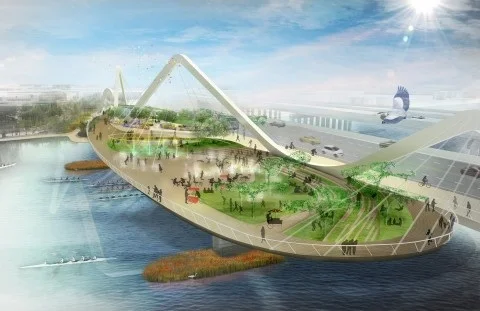
Three concepts shape the proposal from Balmori Associates and Cooper Robertson, both of New York. The predominant architectural feature is an undulating overheard feature called “the Walk,” meant to evoke the daily strolling routine of Frederick Douglass, the famed abolitionist whose former home in Anacostia is a National Historic Site.

“The structure allows for the design of a suspended deck giving freedom to the overall shape, program, and topography of Bridge Park and permits the deck edge to be varied, thin, and elegant,” the team writes in its proposal.

This bridge would meander side to side as it crosses the river, a design the team calls “the Thread.” In the center of the bridge is “the Clasp,” a prominent events space that hangs out over the water.

The architects said they hoped their project “can help re-connect the diverse neighborhoods on both sides of the river, re-engage the Anacostia River, improve the general quality of public health through physical and social activity, and generate new jobs for local citizens of the district.”

*****

Anacostia Crossing

Olin/OMA

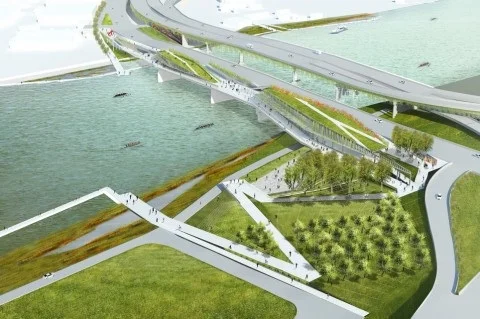
Olin, based in Philadelphia, and the Office for Metropolitan Architecture, in New York,  propose two grand ramps that slope from either end of the bridge, creating a series of paths and a giant ‘X’ shape that would serve as an easily recognizable symbol on the river.

“The intersection point of the two paths shapes the central meeting point of the bridge—an open plaza that provides a flexible venue for markets, festivals, and theatrical performances held throughout the year,” the companies wrote in their submission. “The paths that frame this plaza further enhance the bridge as a hub of activity, providing a sequence of zones designated for play, relaxation, learning and gathering.”

On the slopes, the companies propose a series of special spaces, among them an amphitheater, an urban agriculture center, an environmental education center and a boat launch. Other features include a sculpture garden, interactive art features and a “hammock grove.”

*****

Anacostia Landing

Wallace Roberts & Todd / Next Architects

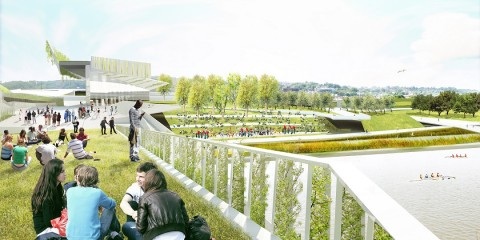
Philadelphia-based Wallace Roberts & Todd teamed with a firm based in the Netherlands, Next Architects, to propose a bridge with a billowy canopy that its designers liken to a “noble and grand old tree” in that it “fulfills multiple and vital needs: providing shade, funneling prevailing breezes, supporting greenery and solar panels, framing public art, and creating the setting for gatherings, frolic, and play.”

“We aim to spotlight the Anacostia River as a bountiful, beautiful, and exciting watercourse, a place where the juncture of human and natural ecologies ‘land’ as a productive, fun, and life-affirming exchange,” they write.

Beneath the canopy and surrounding it the team plans a staggering 35 different amenities arranged in four zones along the length of the bridge and overflowing onto parkland along the eastern banks of the river.

The centerpieces are an amphitheater and a three-story community and education center. For foodies there is an urban farm, market, greenhouse and dining piers. For recreation there are trampolines, climbing nets and an urban beach.

*****

The Crossing

Stoss Landscape Urbanism / Höweler + Yoon Architecture

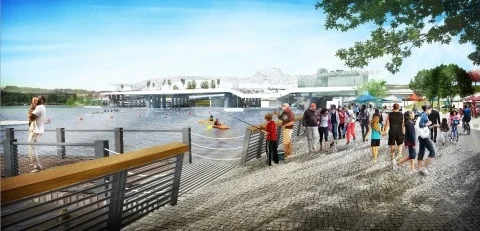
The submission from two Boston firms, Stoss Landscape Urbanism and Höweler and Yoon, is rooted in the history of the river, to the days when ferries escorted workers from Anacostia to their jobs at the Navy Yard on the west side of the river.

“These ferry crossings became as much places of congregation and assembly, places of social exchange, as they were places of passage,” they write. “Our proposal for the 11th Street Bridge Park puts in place a new crossing, one that establishes new connections across and to the Anacostia River and to the burgeoning and socially and culturally rich neighborhoods along its banks.”

They propose a series of angular walkways and park spaces along the bridge and extending along the eastern bank of the river. Two raised structures pop from the bridge’s main plate, creating space for an environmental education center and other enclosed features.

 

image.jpg

image.jpg

image.jpg
image.jpg
Source: http://www.washingtonpost.com/news/digger/...

RIP: IPod


image.jpg

Not everything Apple did during its event on Tuesday was announced on stage by the executive team.

As the company focused the world’s attention on the stage of Cupertino’s Flint Center, it was carrying out a murder in the wings. The victim: theiPod Classic.

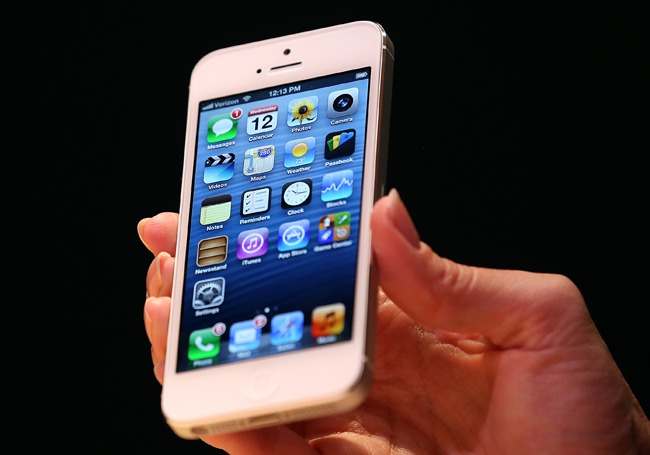
By far Apple’s longest-running product, the iPod Classic – once known simply as the iPod – was introduced in its final form in September 2007: the sixth generation of iPod had a thinner body, longer battery life and an aluminium design. Three months earlier, the iPhone had been introduced and the writing was on the wall for the classic.

At the event where the iPod Classic was introduced – and given its new, respectful moniker – the iPod Touch was also born. It had the advantages of an iPhone bar the cellular connectivity but a price closer to the rest of the iPod line. The Touch was supposed to be the death knell for the classic.

But instead, the design showed a remarkable durability. A large part of that was down to the capacity of the device, which started at 80GB and had been bumped up to 160GB by 2009. Next to an iPod Touch which, even today, maxes out at 64GB of space, it appealed to those with enormous music collections and a desire to carry everything with them all the time.

Even though Apple appeared happy to take the classic fans’ money for the time being, every new hardware announcement was shadowed by the possibility that this would be the end for the venerable MP3 player. It was the last product the company shipped with a 1.8 inch hard-drive, an expensive component liable to fail with over-use. And in a world of streaming music services even the idea of a “music collection” was starting to seem outdated, let alone the idea that it needs to be stored on the same device.

Still, we didn’t expect the murder of the classic to be done with such brutality. Apple’s never been a company for looking back but typically when they discontinue a product they offer up something new as recompense. Not this time. The iPod line was not mentioned once onstage – though a redesign of the iPod touch might come in October – and no time was spared for the classic. The future is touchscreens on our wrists, not scrollwheels in our pockets.

Except. Announcing the Apple Watch, the company’s CEO Tim Cook put special emphasis on the “digital crown”, a whole new input paradigm invented just for the device. “It translates rotary movement into digital data,” he told the audience, dazzling them with the “IR LEDs and diodes” used to make it work. But beneath the bluster, it’s a physical scroll wheel, the same technology introduced in the original iPod in 2001. 

Maybe that’s the send-off the iPod Classic deserved?

Source: http://www.theguardian.com/technology/2014...

Teenagers Just Can't Figure Out the Original NES

Video game technology has come a long way since the Nintendo Entertainment System debuted in the 1980s, so it's no surprise that the teenagers examining the device in the Fine Brothers' latest React video are kind of bemused by the device. "Is this a projector?" one asks. Game of Thrones' Maise Williams thinks it might be a video player; another guesses that it's a Gameboy 1. "I've played with a PlayStation 2," one girl notes, "but this is as old as it gets for me

"It looks like a brick," one boy notes; his friend adds that it looks like it's "from, like, 1920." Another teen says that his dad probably played with it. One boy says its color is "bland," then imagines the meetings inside Nintendo about the NES: "'We're going to make a system that's like, gonna be, like, all futuristic and stuff, but it's going to be beige.'" When asked if they'd ever played a game on the NES, some respond that they have. One girl, though, seems to find the question ridiculous: "I wasn't even born yet!" (Meanwhile, those of us who owned the NES shortly after it debuted in North America are feeling older by the minute.)

Then, of course, they get the opportunity to play Super Mario Bros. Watch as they try to figure out how to open the NES and properly insert the game. When they can't get the TV to stop flashing, they even blow on the cartridge (which we now know didn't actually do anything). When they finally get the game to work, they complain about the controllers and the fact that they can't go back. Ultimately, they rate the NES worse than consoles of today, but acknowledge its role in making video games as huge as they are today.

For added fun, check out this video of the teenagers playing Mike Tyson's Punch-Out!!

Source: http://mentalfloss.com/article/58780/teena...

99 Per Cent Of Sweden's Garbage Is Now Recycled

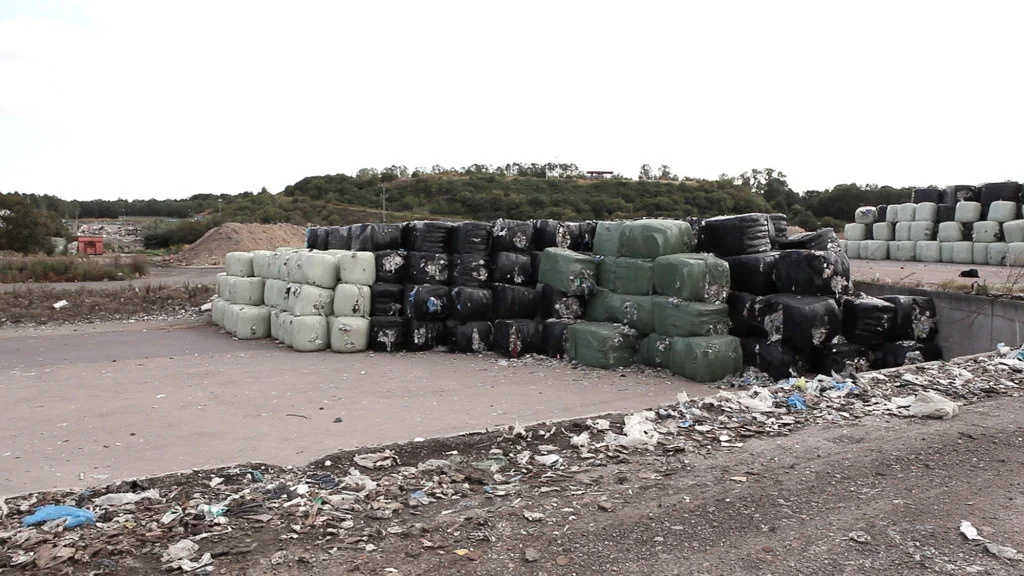
There’s a “recycling revolution” happening in Sweden – one that has pushed the country closer to zero waste than ever before. In fact, less than one per cent of Sweden's household garbage ends up in landfills today.

The Scandinavian country has become so good at managing waste, they have to import garbage from the UK, Italy, Norway and Ireland to feed the country’s 32 waste-to-energy (WTE) plants, a practice that has been in place for years.

“Waste today is a commodity in a different way than it has been. It’s not only waste, it’s a business,” explained Swedish Waste Management communications director Anna-Carin Gripwell in a statement.

Every year, the average Swede produces 461 kilograms of waste, a figure that's slightly below the half-ton European average. But what makes Sweden different is its use of a somewhat controversial program incinerating over two million tons of trash per year.

It’s also a process responsible for converting half the country’s garbage into energy.

“When waste sits in landfills, leaking methane gas and other greenhouse gasses, it is obviously not good for the environment,” Gripwell said of traditional dump sites. So Sweden focused on developing alternatives to reduce the amount of toxins seeping into the ground.

At the core of Sweden’s program is its waste-management hierarchy designed to curb environmental harm: prevention (reduce), reuse, recycling, recycling alternatives (energy recovery via WTE plants), and lastly, disposal (landfill).

Before garbage can be trucked away to incinerator plants, trash is filtered by home and business owners; organic waste is separated, paper picked from recycling bins, and any objects that can be salvaged and reused pulled aside.

By Swedish law, producers are responsible for handling all costs related to collection and recycling or disposal of their products. If a beverage company sells bottles of pop at stores, the financial onus is on them to pay for bottle collection as well as related recycling or disposal costs.

Rules introduced in the 1990s incentivized companies to take a more proactive, eco-conscious role about what products they take to market. It was also a clever way to alleviate taxpayers of full waste management costs.

According to data collected from Swedish recycling company Returpack, Swedes collectively return 1.5 billion bottles and cans annually. What can't be reused or recycled usually heads to WTE incineration plants.

WTE plants work by loading furnaces with garbage, burning it to generate steam which is used to spin generator turbines used to produce electricity. That electricity is then transferred to transmission lines and a grid distributes it across the country.

In Helsingborg (population: 132,989), one plant produces enough power to satisfy 40 per cent of the city’s heating needs. Across Sweden, power produced via WTE provides approximately 950,000 homes with heating and 260,000 with electricity.

Recycling and incineration have evolved into efficient garbage-management processes to help the Scandinavian country dramatically cut down the amount of household waste that ends up in landfills. Their efforts are also helping to lower its dependency on fossil fuels.

“A good number to remember is that three tons of waste contains as much energy as one ton of fuel oil … so there is a lot of energy in waste,” said Göran Skoglund, spokesperson for Öresundskraft, one of the country’s leading energy companies.

So if Sweden burns approximately two million tons of waste annually, that produces roughly 670,000 tons worth of fuel oil energy. And the country needs that fuel to operate its well-developed district heating networks which heat homes in Sweden's cold winters.

This is why the country has taken advantage of the fact a number of European nations don’t have the capacity to incinerate garbage themselves due to various taxes and bans across the EU that prevent landfill waste. There's where Sweden comes in to buy garbage other countries can't dispose of themselves at a reasonable cost.

But trash burning isn’t without controversy. Some critics claim the process as anything but green because it sends more pollution and toxins into the air.

According to a study in the journal of Environmental Science and Technology, more than 40 per cent of the world’s trash is burned, mostly in open air. It’s a process markedly different from the regulated, low-emission processes Sweden has adopted.

Start-up costs for new incineration plants can get pricey and out of reach for some municipalities depending on the integration of processes used to filter ash and flue gas byproducts. Both contain dioxins, an environmental pollutant.

The incineration process isn't perfect, but technological advancements and introduction of flue-gas cleaning have reduced airborne dioxins to “very small amounts,” according to the Swedish Environmental Protection Agency.

Unless manufacturers stop making products with materials that can't be reused or tossed into incinerators, a 100 per cent recycling rate is unlikely to be achieved in our lifetime. Goods that are or contain tile, porcelain, insulation, asbestos, and miscellaneous construction and demolition debris can't be burned safely; they have to be dumped in landfills.

“The world needs to produce less waste,” explained Skoglund.

Sweden's success handling garbage didn't come overnight — the latest results are the fruits of a cultural shift decades in the making.

“Starting in the ‘70s, Sweden adopted fairly strict rules and regulations when it comes to handling our waste, both for households and more municipalities and companies,” Gripwell told HuffPost Canada, referring to the country’s “waste hierarchy” now ingrained in Swedish society.

“People rarely question the ‘work’ they have to do,” she said.

Source: http://www.huffingtonpost.ca/2014/09/02/sw...

Text a Taco


image.jpg


Taco Text is an app by software product design and development studio XOXCOthat can send an image of a delicious taco to people via text message. The app features both “weird sounds” and four different tacos to choose from. Taco Text is currently available on iOS.

Want to eat tacos? Send a taco!
Want to say I love you? Send a taco!
A taco is the perfect message for any occasion!
Tacos!


image.jpg
Source: http://iconosquare.com/tag/textataco